Wedding Social Media Etiquette
A wedding is now photographed by everyone in the room. That is the reality to plan for, not a trend to complain about. The couple who decides in advance what they want shared, who asks for it, and where it should live avoids the two failures that dominate wedding-day stories: a ceremony interrupted by raised phones, and a private moment published before the couple has seen it.
This guide is about agreements, not apps. It covers how to set a photo policy guests will actually follow, what consent means at a party, how to use a hashtag without turning the day into content production, what vendors may publish, and how to clean up afterwards. None of it requires banning phones or hiring a social media manager. It requires one page of decisions made before the invitations go out.
Decide the policy before the paper goes out
The worst time to discover a disagreement is during the ceremony. Sit down together, and with anyone contributing money or expectations, and answer four questions: may guests photograph the ceremony, may they post during the day, may they post pictures of other guests, and may they tag the venue. Write each answer in one sentence. Put the short version on the wedding website FAQ and the longer version in the day-of details you send a week before.
A policy nobody can follow is worse than no policy. 'No phones at all' fails when half the guest list is from out of town and using the camera as their memory. 'Post whatever you like' fails when a grandparent has asked not to appear online, or when a colleague learns about the wedding from a stranger's story. The middle ground is easier to keep: a short phone-free window for the ceremony, phones welcome at the reception, and one clear request about children and guests who have opted out.
- Phones away for the ceremony only; welcome at the reception.
- Ask before posting a photo that clearly shows another guest.
- No posting of children's faces without a parent's agreement.
- State the policy once, with a reason, and then trust your guests.
The unplugged ceremony, without policing guests
An unplugged ceremony is a twenty-minute request, not a moral position. Announce it in three places: the website, a small sign at the entrance, and one sentence from the officiant before the processional. The officiant is the right messenger because guests expect instructions from them, and a reminder from a stranger feels like a shared plan rather than a scolding.
If you want aisle photographs, give the professional team the only permission and say why: 'We have two photographers so we can all be present.' That framing is honest and usually gets a laugh. Ask the wedding party to model the behavior, because guests copy what the couple's closest friends do. If someone still lifts a phone, do not confront them mid-ceremony. A planner or a calm cousin can speak to them afterwards, quietly, and ask for the clip.
- Name the phone-free window precisely: processional to recessional.
- Put the sign where guests queue, not where they sit.
- Brief the officiant and the wedding party first.
- Offer a shared album link for the photos guests do take.
Consent applies to guests, not just to you
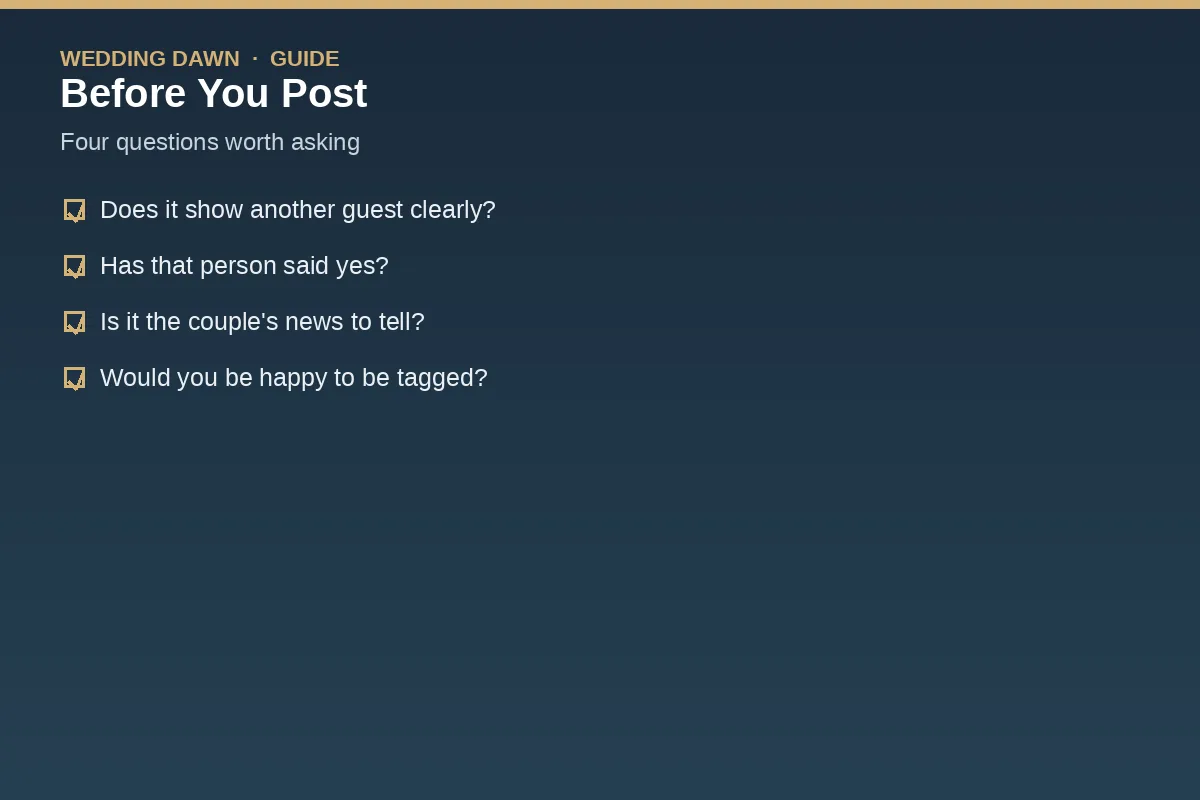
Guests are not public figures because they attended a wedding. Some are avoiding an ex, some are job-hunting, some have a family situation you know nothing about. The safe default is to ask before posting a photo in which someone is recognisable, and to accept a no without debate. This applies most strongly to children: many parents have firm rules about their child's face online, and it is not the couple's call to override them.
At the event, asking takes four seconds: 'Is it okay if this goes on Instagram?' After the event, a group message works. If someone asks you to remove a photo, remove it first and discuss later; the argument about intent is never worth the cost of leaving it up. Photographers need the same briefing. A good contract says how images of guests may be used, and a couple can ask for a private gallery rather than a portfolio piece.
- Ask before tagging; untag immediately if asked.
- Keep children's faces out unless a parent has said yes.
- Do not publish guest contact details, addresses, or room numbers.
- Give the photographer a written list of anyone who must not appear.
A hashtag should help people find photos, not manufacture content
A wedding hashtag has one practical job: gather guest photos in one place so you can find them later. Keep it short, spell it out on the tables, and check that it is not already attached to something unpleasant. Do not turn it into a contest, a daily prompt, or an obligation. Guests who enjoy posting will post; guests who do not should not be made to feel they are failing at your wedding.
If you want a reliable record, ask a friend to save stories to a shared album, or use a service that collects tagged posts and lets you download them. Be careful with public tag pages: they expose guests to strangers and can scrape names. A private, invite-only album is usually the better tool. If you do use a public hashtag, tell guests what it is for and where the photos will live.
- Short, pronounceable, and checked for unfortunate meanings.
- Printed on the menu or a small card, not shouted from a microphone.
- One reminder at most; no pressure and no prizes.
- Offer a private album for anyone who prefers not to post publicly.
What not to post, and when
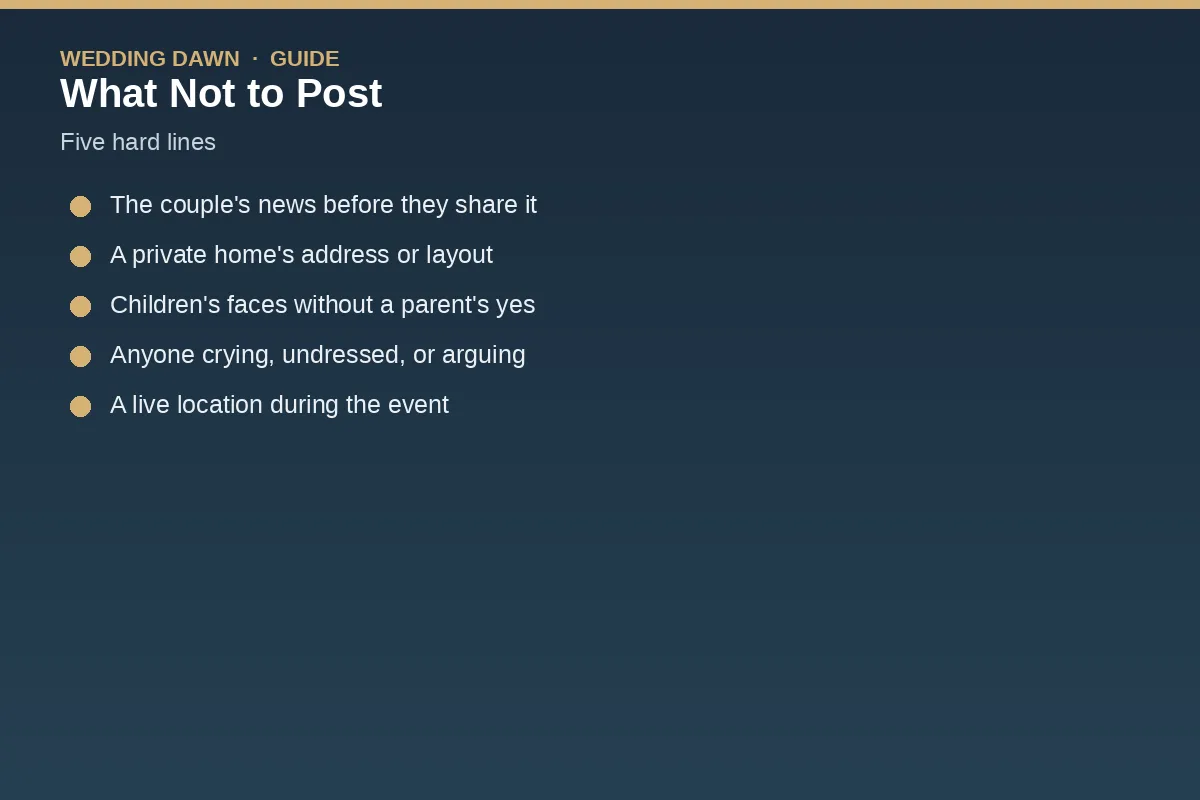
Do not post the couple's news before they do. Engagements, pregnancies, and house purchases travel faster online than through family, and a cousin's congratulations can spoil an announcement planned for dinner. Do not post the exact address of a private home while the event is running, or photographs that reveal the layout of the property. Do not livestream a ceremony without asking every person whose face or voice will appear. And do not post a photo of the bride or groom in a state they would not choose, simply because it got a reaction.
Timing matters as much as content. Posting during the ceremony is the most common complaint from couples and photographers, not because phones are evil, but because a raised screen blocks the view of the person behind. If you must post, wait for a natural break. The couple's own announcements should wait until the people who matter most have heard in person or by phone. A public post is not a substitute for calling a parent.
- Never announce an engagement or pregnancy you were told in confidence.
- No live location tags during the event or the honeymoon.
- No photos of someone crying, undressed, or in an argument.
- Ask before posting the couple's children, house, or car.
Vendor credits, gifts, and paid posts
Vendors often ask to feature a wedding, and that is normal. Permission, however, runs through the couple, not through the photographer's portfolio. Before the day, ask each vendor what they plan to publish and whether they will name the couple. A neutral credit such as 'venue: X, photography: Y' is usually welcome; a post that names the couple, tags their friends, and reveals the date is a different request. If a vendor offers a discount in exchange for promotion, get the terms in writing and disclose the arrangement. Undisclosed paid promotion is a trust problem and, in many places, a legal one.
- Ask vendors for their posting plan before the wedding.
- Agree on whether names, faces, and dates may appear.
- Get any discount-for-promotion deal in writing.
- Disclose paid or gifted promotion clearly.
The day after, and the long tail
Most etiquette failures happen after the wedding, when the adrenaline is gone and the photos arrive. Ask before posting the 2 a.m. group shot; the person on the left may have called in sick the next morning. Give guests a way to request removal that does not require a public confrontation: a line in the group chat, or a note in the thank-you card. Keep the guest list and the photo album separate from anything public.
When the wedding is over, take down or lock the pages that carry addresses, phone numbers, and the schedule. A wedding website left online is a small privacy leak that lasts for years, and an old hashtag keeps collecting strangers' posts long after the day. Archive the photos you want to keep, export the guest list, and then close the public-facing pieces. The goal is not to disappear from the internet; it is to leave only what you would be happy for a stranger to find.
- Ask before posting group photos the morning after.
- Provide a private way to request removal.
- Lock or delete the wedding website within a month.
- Archive the gallery locally and keep the guest list private.
Step by step
Agree on four answers
Ceremony photos, posting during the day, other guests' faces, venue tagging. One sentence each.
Publish the short version
Website FAQ, entrance sign, and one line from the officiant.
Brief the people with authority
Photographer, planner, wedding party. They model and enforce the policy.
Make asking normal
Ask before tagging, accept no immediately, and offer a private album.
Close the loop afterwards
Remove requested photos, lock the site, archive the gallery, keep the list private.
Quick checklist
- Photo policy written in one sentence per question.
- Phone-free window named and announced three ways.
- Officiant and wedding party briefed.
- Guests know how to ask for a photo to be removed.
- Children's faces protected by default.
- Hashtag checked and printed once, without pressure.
- No live location or address posted during the event.
- Vendor posting plans agreed in writing.
- Paid or gifted promotion disclosed.
- Website locked and gallery archived after the wedding.
FAQ
Is it rude to ask guests not to use phones during the ceremony?
No, if you ask once, explain why, and keep the request narrow. A twenty-minute window with a clear reason is easy to follow; a blanket ban on phones for the whole day usually is not.
Do we need a wedding hashtag?
No. It is useful if you want to collect guest photos in one place. If you use one, keep it short, print it once, and make clear whether the posts will be public.
Can we ask a guest to delete a photo?
Yes, and they should delete it without an argument. The same applies in reverse: if a guest asks you to remove a photo of them, remove it first and discuss later.
May our photographer post our wedding on social media?
Only with your agreement. Ask what will be published and whether you will be named. Many photographers will use detail shots or a private gallery if you prefer not to appear.
What should we do with the wedding website after the day?
Lock it or take it down within a month. Remove RSVP data, addresses, and schedules, export the guest list, and archive the photos you want to keep.
Sources
- FTC — Consumer Advice: Advertising and endorsements Disclosure principles for paid or gifted promotion, reviewed 2026-11.
- NIST — Privacy Framework Data minimisation applied to guest lists and public pages, reviewed 2026-11.
- W3C — Web Content Accessibility Guidelines Accessible forms and readable text for wedding websites, reviewed 2026-11.