Wedding Registry Setup Guests Can Actually Use
A wedding registry is the one part of wedding planning where the goal is to be a little boring. A guest should be able to open your list, find something in their budget, and buy it without wondering whether someone else already has. Most registry trouble — duplicate gravy boats, three people splitting one place setting, cash requests that land badly — starts when the list is assembled store by store instead of designed from the guest's side of the screen.
This guide sets out a setup you can finish in about ninety minutes: one registry page, two or three stores, an explicit cash policy, and a gift log that ties every box to a thank-you note. It assumes a guest list between 40 and 200 and works whether you are marrying in a city flat or a garden.
Start with the guest list, not the department store
Gift culture follows the shape of the wedding. A 40-person restaurant dinner usually means smaller, more personal gifts and a higher share of cash. A 200-person weekend with travel involved means guests have already spent money on flights and hotels, and a modest registry reads as considerate rather than stingy. Neither is a comment on your taste; it is simply how people budget.
Before you open an account anywhere, answer three questions on paper:
- What is the median journey for a guest — a taxi across town, or a flight and two nights away?
- How many guests are close enough to buy a joint gift of 150 or more?
- Do you have space at home for anything large, or will a box need a storage unit?
The answers decide the mix. Travel-heavy weddings need more small items and a clear cash option. Local weddings with older family friends can carry more mid-range homeware. A small flat rules out the stand mixer you will never unbox; a house with a spare room can happily accept a second set of linen.
Decide the cash question before anyone asks
Cash is the most common registry request in most of the world, and also the one couples handle most awkwardly. The fix is to name it, not hint at it. If you want money toward a honeymoon, a first home, or a specific course, create a labelled fund with a one-line purpose. If you genuinely do not want cash, leave it off the list and say nothing; a registry without a cash option is a complete answer, not an evasion.
What you should avoid is the half-measure: no fund on the page, but a parent telling guests that checks are easiest. That produces the exact situation you were trying to dodge, because now the information is unofficial and unevenly distributed. Whatever you decide, put it in one sentence on the registry page, in the same voice as the rest of the site.
A neutral sentence works better than an apology: “If you would rather contribute to our first home than buy an object, there is a fund on this page.” No explanation of your finances, no “we really don't need anything”, no list of reasons. Guests are not auditing you; they are looking for a clear option.
Build the list in three layers
A registry that only contains one price band forces guests into either overspending or choosing nothing. Three layers solve this without turning the page into a department store:
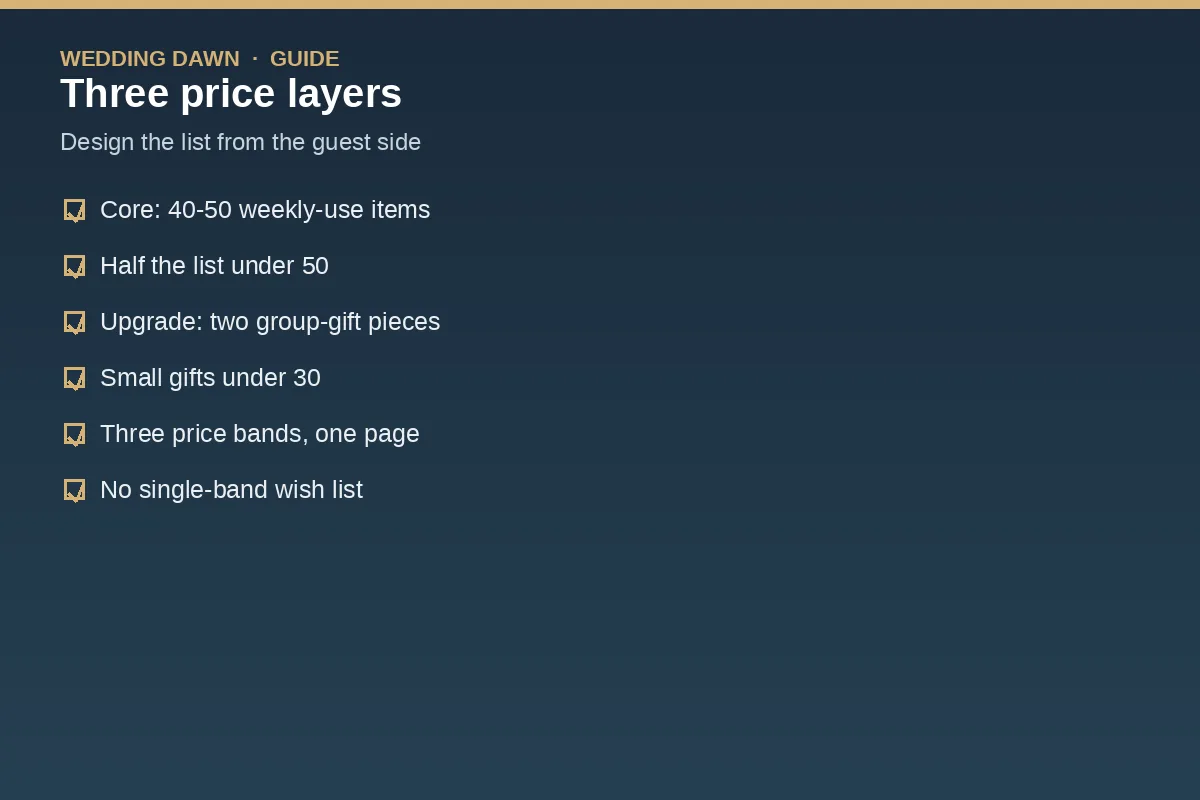
- Core — the things you will use every week: sheets in your size, towels that match the bathroom, a decent knife, four more dinner plates. Aim for 40 to 50 items, with several under 40.
- Upgrade — one or two considered pieces you would not buy yourself: a good stand mixer, a proper serving dish, a set of glasses that survives the dishwasher. These are the gifts guests like to give together.
- Small and personal — recipe books, garden tools, a board game, a specific paperback you loved. These fill the gap for colleagues and plus-ones who want to give something thoughtful under 30.
Cover at least three price bands and note the band in the item description if the store allows it. Roughly half the list should sit under 50, a third between 50 and 150, and the rest above that. When guests can see the range, they stop guessing and start buying.
Write the page copy that prevents duplicate gifts
Most duplicate gifts are not a guest problem; they are a link problem. If your registry lives on three store sites and an invitation insert, someone will buy from the wrong list and never check whether the item was already claimed. Keep one URL that you control, whether that is your wedding website or a standalone page, and link out to each store from it.
Then add two sentences that do more work than any etiquette column. The first explains the mechanics: “We are registered at A and B; the buttons above go straight to each list, and both update automatically when something is bought.” The second releases the guest from guessing: “If you cannot find the list or the item you wanted is gone, please don't worry — a card is more than enough.”
That second line quietly removes the pressure that causes off-list gifts. Put the registry link on the wedding website, in the invitation details card, and in the answer to anyone who asks; keep it out of the main invitation itself if your circle considers that rude. The wording rules for invitations are worth reading before you print anything.
Handle the etiquette moments before they happen
Four situations cover almost every registry conversation. Decide your answer now, so you are not improvising at a family dinner:
- A guest asks what you really want, meaning cash. Answer plainly: “The fund on the page is genuinely the most useful thing for us.” Do not add a disclaimer.
- A relative offers an heirloom instead of a gift. Accept it, and remove one comparable item from the list so the gesture does not look redundant.
- Someone buys something not on the list. Thank them for the object, not for the thought, and do not ask for the receipt unless it is broken.
- Two households split a large gift. Let them, and note both names in your gift log so the thank-you addresses the right people.
The common thread is that you never explain your registry policy twice. One sentence, repeated calmly, is more gracious than a paragraph of justification. If a guest pushes, the answer is still the same sentence, followed by a question about their journey or their children.
Set up the gift log before the first box arrives
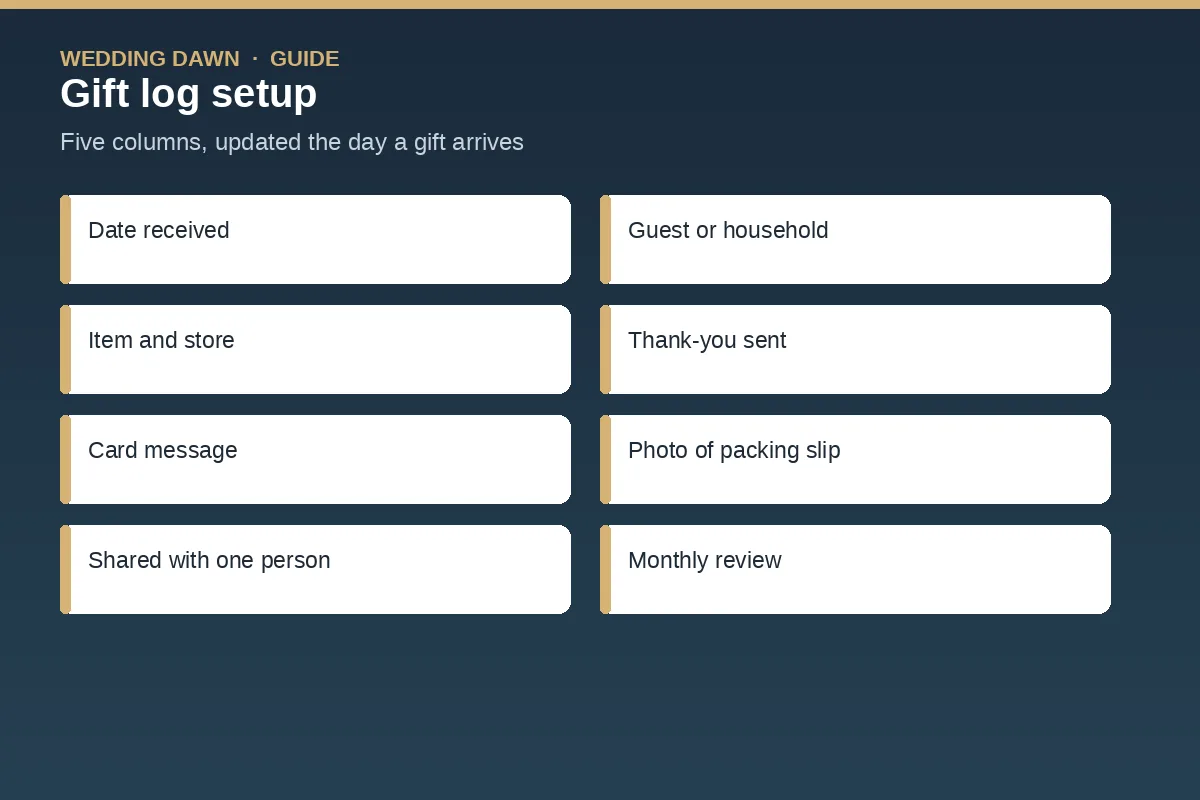
Gifts start arriving the week the invitation lands, and the thank-you note you write in January depends on a note you make in June. A gift log is a single spreadsheet with five columns: date received, guest or household, item, store, and whether a thank-you has been sent. Add a sixth for the card message if you keep cards, because the wording is often the only personal detail you will remember later.
Two habits make the log reliable. First, photograph the packing slip or gift note before you recycle it, and drop the photo into a folder named by month. Second, write the entry the day the box arrives, not at the end of the month. Fifteen seconds now saves an hour of guessing in autumn, and it means the thank-you can mention the actual object rather than a vague “your lovely gift”.
A ninety-minute setup you can finish tonight
If the wedding is still months away, do this in one sitting rather than spreading it over weeks. The order matters, because each step removes a decision from the next:
- List the guest households and mark the travel-heavy ones.
- Choose two stores and one cash fund; skip anything you cannot explain in a sentence.
- Add core items first, then upgrades, then small gifts, aiming for three price bands.
- Publish one registry page with a single link and the two sentences above.
- Open the gift log and share it with one other person.
- Set a calendar reminder for the first of each month to review stock and remove sold-out items.
Close the list and deal with late gifts
Close or hide the registry about two weeks before the wedding. At that point guests who have not bought are either coming with a card or waiting to see you in person, and a live list mostly creates last-minute shipping problems. Keep the gift log open until the last thank-you is sent; late gifts usually arrive within six weeks of the wedding and are the easiest ones to forget.
If something arrives damaged, contact the store before the return window closes and tell the guest only if they ask. If you receive a duplicate, exchange it quietly and note the substitution in the log so your thank-you still describes the right object. Neither situation is a crisis; both become one when the log has gaps.
A registry is not a measure of generosity. It is a small piece of information design: one page, clear price bands, an honest cash option, and a log that keeps the thank-yous honest. Get those four right and the subject stops coming up, which is exactly what you want. From there, the budget spreadsheet and the thank-you notes are the only parts that still need your attention.
Set up the registry in six steps
Size the guest list
Count households, not people, and mark the ones traveling more than an hour.
Pick two stores and one fund
Choose shops your guests already use, plus a single labelled cash fund with a one-line purpose.
Build three price layers
Add 40 to 50 core items, two upgrades and a handful of small gifts, with half the list under 50.
Publish one page
Put every store link on one URL you control, with the two sentences that explain how it works.
Open the gift log
Create five columns and a shared folder for photos of packing slips before the first box arrives.
Schedule maintenance
Review monthly, remove sold-out items, and close the list two weeks before the wedding.
Registry checklist
- Guest households counted, travel-heavy ones marked
- Two stores chosen, both already familiar to guests
- One cash fund with a one-line purpose, or none at all
- 40 to 50 core items in the right sizes
- Two upgrade pieces suitable for group gifts
- Small gifts under 30 for colleagues and plus-ones
- Half the list under 50, a third between 50 and 150
- One registry URL that you control
- Two sentences explaining links and automatic updates
- Gift log with five columns, shared with one other person
- Folder for packing-slip photos, named by month
- Calendar reminder on the first of each month
- List closed two weeks before the wedding
- Thank-you tracking kept open until the last card is sent
Frequently asked questions
How many items should a wedding registry have?
Roughly two to three items per invited household, capped around 80. For 100 guests that means 60 to 80 items, spread across three price bands so nobody has to choose between overspending and arriving empty-handed.
Is it rude to ask for cash instead of gifts?
It is normal in many countries and increasingly accepted elsewhere, provided you are explicit and give an alternative. A labelled fund with a clear purpose, stated once on the registry page, is politer than letting relatives spread the message informally.
Should the registry link go inside the invitation?
In most etiquette traditions, no: put it on the wedding website, a details card or the shower invitation, and let close family answer when asked. If your circle expects it in the main invitation, follow local custom rather than a general rule.
What do we do about guests who buy off-list?
Thank them for the specific object and keep it if you can use it. If it duplicates something, exchange it quietly and record the substitution in your gift log so the thank-you note describes what you kept.
When should we close the registry?
About two weeks before the wedding. After that, a live list mainly produces last-minute shipping problems; guests who have not bought will bring a card or hand you something in person.
Do we need a gift log if the store tracks purchases?
Yes. Store dashboards only cover that store, often only online orders, and rarely record the card message. One shared spreadsheet across all stores is the only reliable basis for thank-you notes months later.
See all frequently asked questions →
Sources
- The Knot — Wedding registry etiquette Etiquette positions on cash funds, invitation wording and guest questions; checked 2026-11.
- Zola — How to build a wedding registry Price-band distribution and item counts referenced in the three-layer section; checked 2026-11.
- Honeyfund — Cash funds and honeymoon registries How labelled funds are presented to guests; checked 2026-11.