How to Postpone a Wedding Without Losing the Plan
Postponing a wedding is not a canceled wedding with a later date attached. It is a second round of planning, done under pressure, with money already spent and people already told. Couples who handle it well do not start by picking a new Saturday. They start by finding out what is refundable, what is transferable, and what will be lost no matter which date they choose.
This guide is an order of operations, not a pep talk. It assumes the decision is already made, or nearly made, and that you need to move through it without burning deposits, friendships, or the relationship itself. Work through the steps in sequence. Most of the damage in a postponement comes from announcing first and reading contracts later.
Name the reason before you name the date
Write down the real reason in one sentence. Health, money, visa and travel problems, a family emergency, a venue that closed, or simply a wedding that grew past what you can pay for. The sentence is not for guests. It is for you, because it decides what kind of postponement this is.
A short delay of a few months is mostly a scheduling problem. An indefinite postponement is a planning reset. A postponement caused by money needs a smaller wedding, not just a later one. A postponement caused by a visa or a deployment may have a fixed external timetable that no amount of negotiation can move. Each one leads to a different conversation with vendors.
- Short delay: keep the same vendors, the same size, and the same plan.
- Financial reset: renegotiate the guest count and the scope before the date.
- External constraint: ask for a force-majeure or rescheduling clause in writing.
- Indefinite pause: stop new spending now and put every contract on hold.
Do the money math before you announce
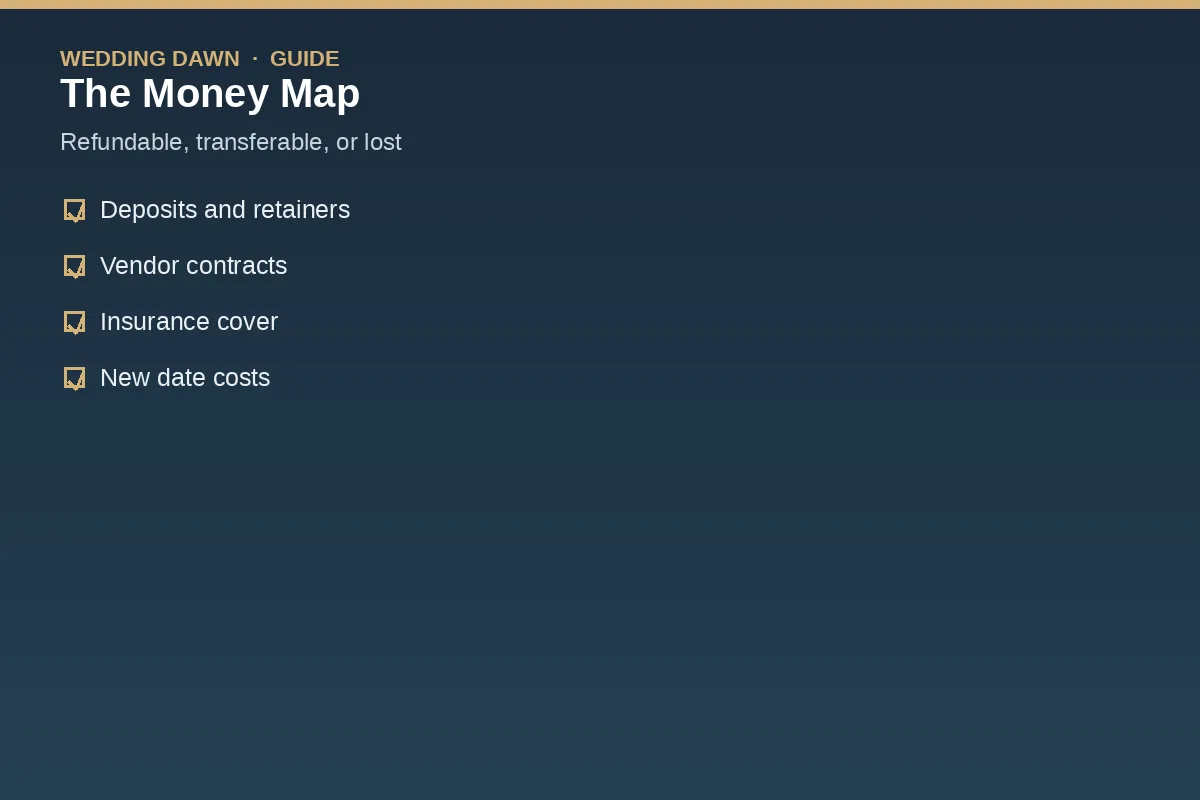
Make a single table with four columns: what you have paid, what is refundable, what can be moved to a new date, and what is lost if you walk away. Add the cost of the new date on top. Most couples discover that the cheapest option is not the furthest date but the one their existing vendors can actually serve.
Call it a postponement only when the numbers support it. If deposits are non-refundable and the venue will not move the date without a second fee, a smaller wedding on the original date may cost less than a large one a year later. That is not a failure. It is arithmetic.
- List every payment with the date it was made and the card or account used.
- Mark each one refundable, transferable, or lost, with the contract clause that says so.
- Add the new date's costs: travel, lodging, and any fresh deposits.
- Set a ceiling you will not cross, and write it down before family offers opinions.
Read every contract in writing
The vendor's friendly verbal reassurance is not a variation. Find the clause on rescheduling, cancellation, force majeure, and transferability. If the contract is silent, ask for an amendment by email and keep the reply. A written email chain is evidence; a phone call is a memory.
Prioritise the vendors with the largest deposits and the least flexibility: venue, caterer, photographer, and hotel block. Florists and DJs are usually easier to move. Planners can often absorb a date change as part of their existing fee, but only if you ask before you sign anything new.
- Ask each vendor for the exact reschedule terms and any fee in writing.
- Request one amendment per contract rather than a new contract.
- Confirm the new date in writing only after every major vendor has agreed.
- Keep a single folder with every email, amendment, and receipt.
Tell people in a deliberate order
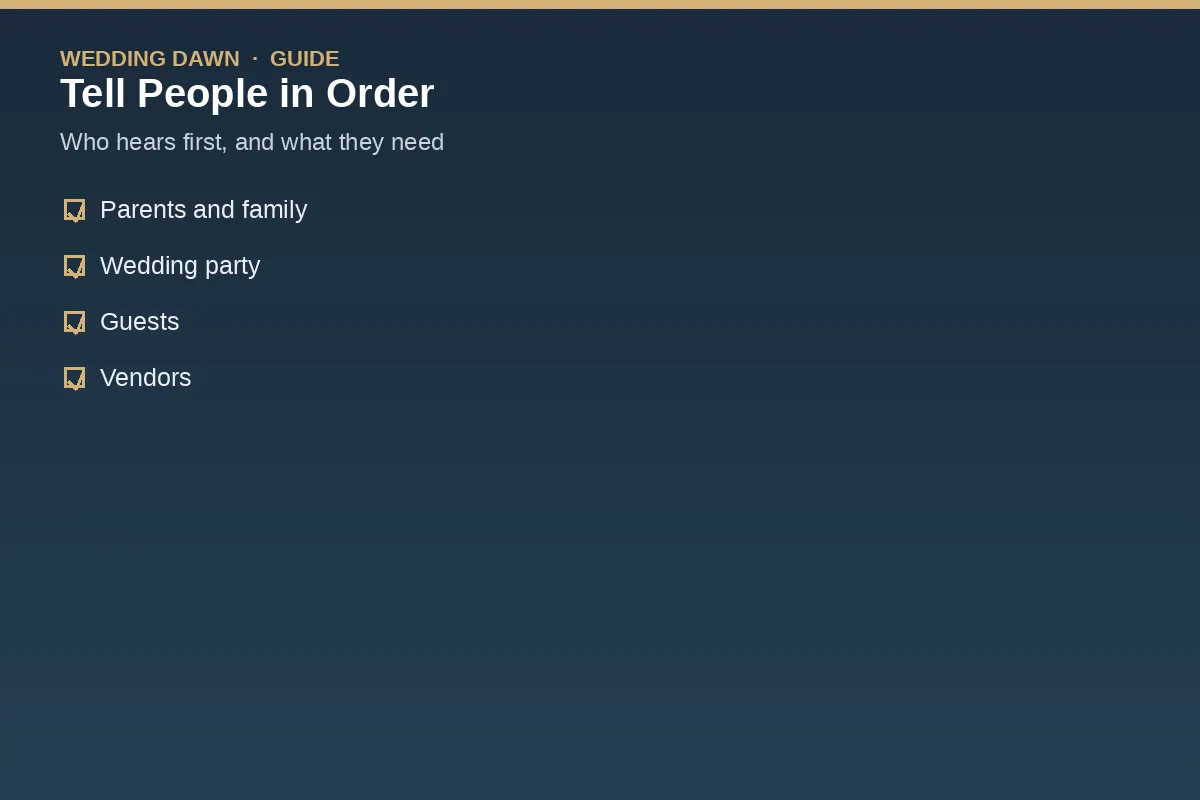
The order is not about hierarchy. It is about who needs to act. Tell the people whose money, travel, or work schedule is affected first, and give them enough information to make a decision. Then tell the wedding party, then the guests. A public announcement before the wedding party knows is how a postponement becomes a family argument.
Keep the message short and factual: the date is changing, the reason at the level of detail you are comfortable sharing, what guests should do about travel and gifts, and when they will hear the new date. Do not apologize more than once. Do not promise a date you have not confirmed.
- Parents and anyone contributing money: a call, before anything is public.
- Wedding party: a call or a small group message with the practical facts.
- Guests: one clear message with travel, gifts, and next-update timing.
- Vendors: written notice in the same week, even if the new date is unknown.
Reset the legal and admin details
A marriage license, an officiant booking, and a venue permit all have dates attached. Check the validity window for the license in the state or country where you will marry; many are valid for only 30 to 90 days, so a license obtained for the old date may be useless for the new one. Rebook the officiant and confirm the permit for the new date.
If you already sent invitations, update the wedding website, the RSVP deadline, and any hotel block. Ask the hotel whether the block can move or must be released and rebooked. Cancel or move travel insurance only after reading the policy; some cover supplier failure, most do not cover a change of mind.
- Check the marriage license validity window for the new date.
- Confirm the officiant and the venue permit in writing.
- Move or release the hotel block; do not let it expire silently.
- Update the website, RSVP deadline, and registry delivery details.
- Read the wedding insurance policy before canceling anything.
Keep the plan you already paid for
The work you did is an asset. The guest list, the seating chart, the menu tasting notes, the shot list, and the timeline can all survive a date change. Ask each vendor to hold the existing brief rather than starting over. A photographer who already knows your family will do better on the new date than a cheaper one who does not.
If the new date is far away, put the plan in a shared document with a clear version and a note on what still needs confirming. Do not keep it in your head for a year. When planning restarts, you want to reopen a file, not reconstruct a wedding from memory.
Protect the relationship under pressure
Postponement puts a couple under the same kind of strain as a renovation: money is committed, decisions are forced, and relatives have opinions. Agree on who owns which conversation. One person handles the venue and the caterer, the other handles family and guests, and neither renegotiates the other's contract without telling them.
Schedule one short weekly check-in about the postponement and then stop talking about it for the rest of the week. The wedding is not the whole relationship, and a date change is not a verdict on it. If the reason is money or health, get the awkward numbers and the medical facts on the table early, while there is still room to solve them.
- Split vendor and family conversations between the two of you.
- Hold one weekly update; keep the rest of the week wedding-free.
- Agree what you will not compromise on before you talk to relatives.
- Ask for help with the admin, not just sympathy.
A postponed wedding is still your wedding. The date is logistics; the marriage is the point. Move the money and the contracts carefully, tell people plainly, and choose a date you can actually keep. If the new date is right, the wait will feel like preparation rather than loss.
Step by step
Write the one-sentence reason
Decide whether this is a short delay, a financial reset, an external constraint, or an indefinite pause. Every later decision follows from that label.
Build the four-column money table
Paid, refundable, transferable, lost. Add the new date's cost. Do this before you call a single vendor or relative.
Amend contracts in writing
Ask each vendor for reschedule terms and fees by email. One amendment per contract; no new contracts until the new date is confirmed.
Notify in order of action
Family and contributors first, wedding party second, guests third, vendors in the same week. Keep the message factual and short.
Reset the legal and travel admin
Check the marriage license window, rebook the officiant, move the hotel block, and update the website and RSVP deadline.
Quick checklist
- One-sentence reason written down and agreed by both partners.
- Every payment listed with date, amount, and payment method.
- Each cost marked refundable, transferable, or lost, with the contract clause.
- New date's full cost calculated before committing.
- Reschedule terms requested in writing from every major vendor.
- Amendments signed or confirmed by email for venue, caterer, photographer, hotel.
- Marriage license validity window checked for the new date.
- Officiant and venue permit reconfirmed in writing.
- Hotel block moved or released; website and RSVP deadline updated.
- Parents, wedding party, guests, and vendors told in that order.
FAQ
Do we lose our deposits if we postpone?
Not automatically. Read the rescheduling clause: many venues and caterers will move a deposit to another date within a set window, sometimes with a fee. Photographers and planners are often more flexible than contracts suggest. Get the answer in writing before you announce anything, and treat a verbal yes as provisional.
Should we tell guests before the new date is confirmed?
Tell the people who must act, such as parents, wedding party, and anyone who has booked travel, as soon as the old date is no longer viable. Hold the broad announcement until you can give a clear instruction about travel and gifts. If the new date is months away, one message now and one when it is confirmed is better than silence followed by confusion.
What happens to our marriage license?
It usually expires. Validity windows vary by state and country, commonly 30 to 90 days, and some licenses must be used in the same jurisdiction that issued them. Check the official rule for the place where you will marry and plan to apply again inside the new window rather than assuming the old license carries over.
Is wedding insurance worth it for a postponement?
Only if the policy covers the specific cause. Most policies cover supplier failure, extreme weather, or illness with documentation, and exclude a voluntary change of date. Read the exclusions before canceling or buying anything new. If the reason is already known when you buy, it will almost certainly be excluded.
How do we tell family without turning it into a fight?
Tell the people who contribute money or need to change plans first, by phone, with the practical facts and a clear next step. Do not open the floor for a debate about whether the postponement is necessary. Give one reason, one plan, and one date for the next update. Arguments usually come from being surprised, not from the decision itself.
Sources
- FTC Consumer Advice — shopping for a wedding or event Guidance on deposits, cancellation terms, and event contracts; checked 2026-11.
- USA.gov — marriage license requirements State-level license rules and validity windows; checked 2026-11.
- NAIC — consumer insurance resources How to read policy exclusions and check an insurer; checked 2026-11.