Wedding Photo Rights: Copyright, Prints, Files
Wedding photography contracts often use the word copyright as if it were a single thing. It is not. Copyright is a bundle of rights: who may copy the images, who may sell them, who may publish them, who may edit them, and who may license them to someone else. Most couples need only a few of those rights, and most photographers transfer only a few. The confusion begins when neither side says which ones.
The practical question is not who owns the photos in some abstract sense. It is: can we print them, share them, back them up, make an album, and still have them in twenty years? Answer those five questions in writing, and the legal language becomes much less frightening.
What the contract actually transfers
In the United States, the photographer generally owns the copyright from the moment the shutter clicks, unless the contract says otherwise. What you buy is a license: permission to use the images in specified ways. A good contract states the license clearly: personal use, unlimited prints, social media, family sharing, and whether commercial use is excluded.
Ask for the license in plain language, then check the fine print for limits: number of prints, file resolution, watermarks, expiry, or a requirement to credit the photographer. A license that expires in five years is not the same as one that lasts forever. A license limited to personal prints may not cover a photo book you sell, a website you run, or a sponsor post.
Print release versus full copyright
A print release is the most common document couples actually need. It tells a lab that you are allowed to print the images, and it usually covers personal use only. It does not make you the copyright owner, and it usually does not allow you to sell the images or license them to a brand.
Full copyright transfer is rare, expensive and often unnecessary. If a photographer offers it, read what is excluded: raw files, the right to use the images in their portfolio, or future reprints. If you do not need to resell the photos, a broad, perpetual, worldwide personal-use license is usually better value than an ownership transfer.
The delivery timeline, and what edited means
Ask when the gallery will be delivered, how many images it will contain, and what edited means in this contract. For many photographers it means color correction, cropping and basic retouching of a selected set, not every frame. A contract that promises all images edited may be promising something the photographer cannot deliver at the quality you expect.
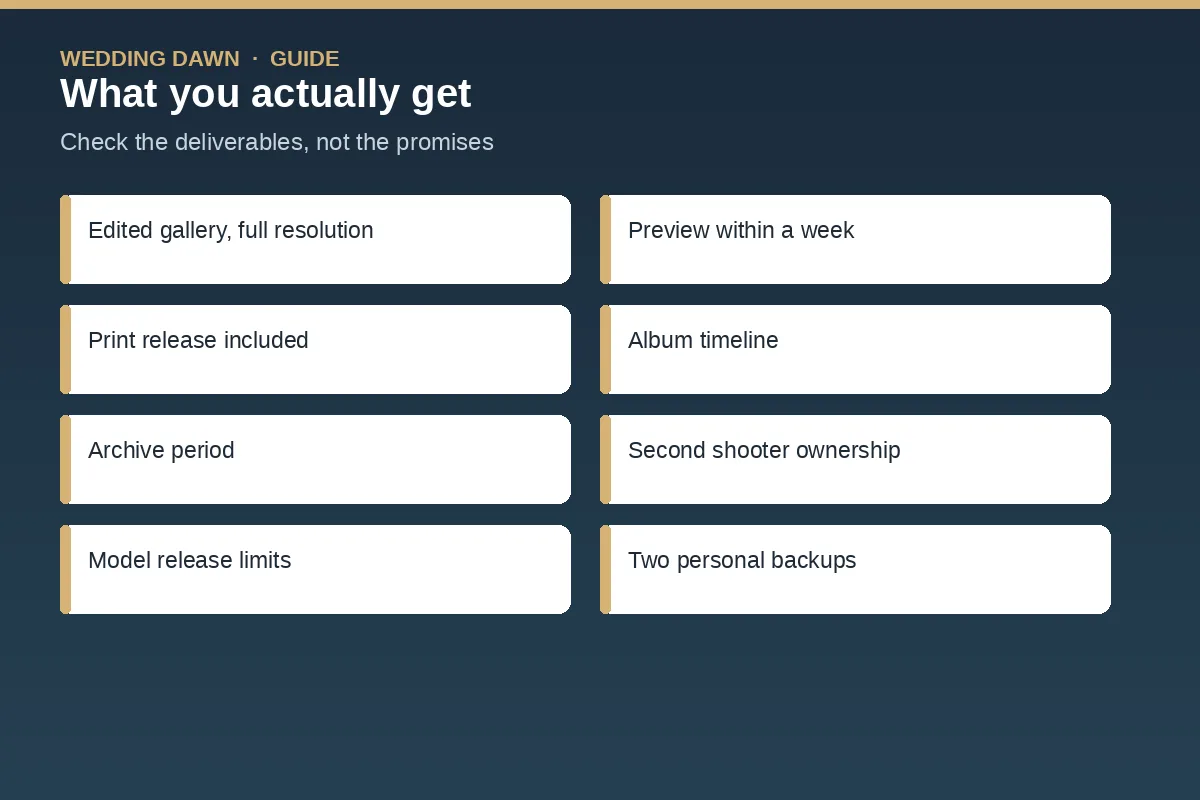
Get the number in writing as a range, not a minimum: 500 to 700 edited images, delivered within eight weeks, with a preview of 20 to 30 within one week. Ask what happens if the deadline slips: a new date, a discount, or a written explanation. A timeline without a consequence is a hope, not a term.
Raw files: why photographers say no
Raw files are the unprocessed sensor data, not photographs yet. Photographers often refuse to deliver them because they are large, unfinished, easy to mis-edit, and part of the artist's working process. That refusal is normal; it is not automatically a red flag. What matters is whether the contract is clear about it before you sign.
If you want raw files, ask early and expect a higher price or a firm no. If you are buying them for archival reasons, ask instead for high-resolution edited JPEGs plus a written backup commitment. For most couples, a complete edited gallery in full resolution is more useful than a folder of files they cannot open.
Social media, tagging and privacy
Ask whether the photographer may post the images, and whether you can opt out. Many contracts include a portfolio and social media clause; a good one lets you say no to identifiable images of vulnerable family members or to any public posting at all. Put your preference in writing before the wedding, not after.
Check the credit requirement. Some licenses require a tag or a credit every time you post; others do not. If you are likely to share images widely, ask for a credit-free personal license, or agree on a simple line you can paste. Do not assume that buying the gallery means buying the right to post it without credit.
Album design and printing
If an album is included, ask who designs it, how many rounds of changes are included, and when it must be approved. Album timelines are the most common source of post-wedding friction: the photographer is waiting for your choices, you are waiting for the design, and the anniversary arrives before the book does.
Ask for the print lab, the paper and the size before you pay. If you want to print yourself, confirm that the license covers a professional lab and that the files are large enough. A file sized for social media will not make a good 16 by 20 print, even if the contract says you may print.
Backups, archives, and studio closure
Ask how long the photographer keeps the gallery online and how long the files are archived. A common answer is one year online and five years archived, but it varies. Get it in writing and download the full gallery to two locations of your own within the first month. Do not treat the photographer's cloud as your backup.
Ask what happens if the studio closes or the photographer becomes unavailable. A professional contract names a successor, an archive location, or a process for retrieving files. If it says nothing, ask for a clause. This is not a morbid question; it is the same question you would ask a bank.
Second shooters, assistants and ownership
If a second shooter or an assistant takes photographs, the contract should say who owns their work and whether their images are included in your gallery. In most cases the lead photographer's company owns or licenses the work, but confirm it. Otherwise you may find that a favorite image belongs to someone you have never met.
Ask whether the named photographer will actually shoot the wedding, and what happens if they are ill. A substitution clause is normal; a silent substitution is not. If a specific person is the reason you booked, put their name and a substitution rule in the contract.
Model release and portfolio use
A model release allows the photographer to use your images for promotion. It is often bundled into the contract, and many couples are happy to agree. You can still negotiate limits: no images of children, no images with identifiable guests, no use in paid advertising, or approval before publication.
If you say no to all promotional use, expect to pay more or to be turned down by some photographers. That is a business decision on both sides, not a moral one. Decide what you are comfortable with before the meeting, and write it down rather than relying on a conversation.
What to negotiate before signing
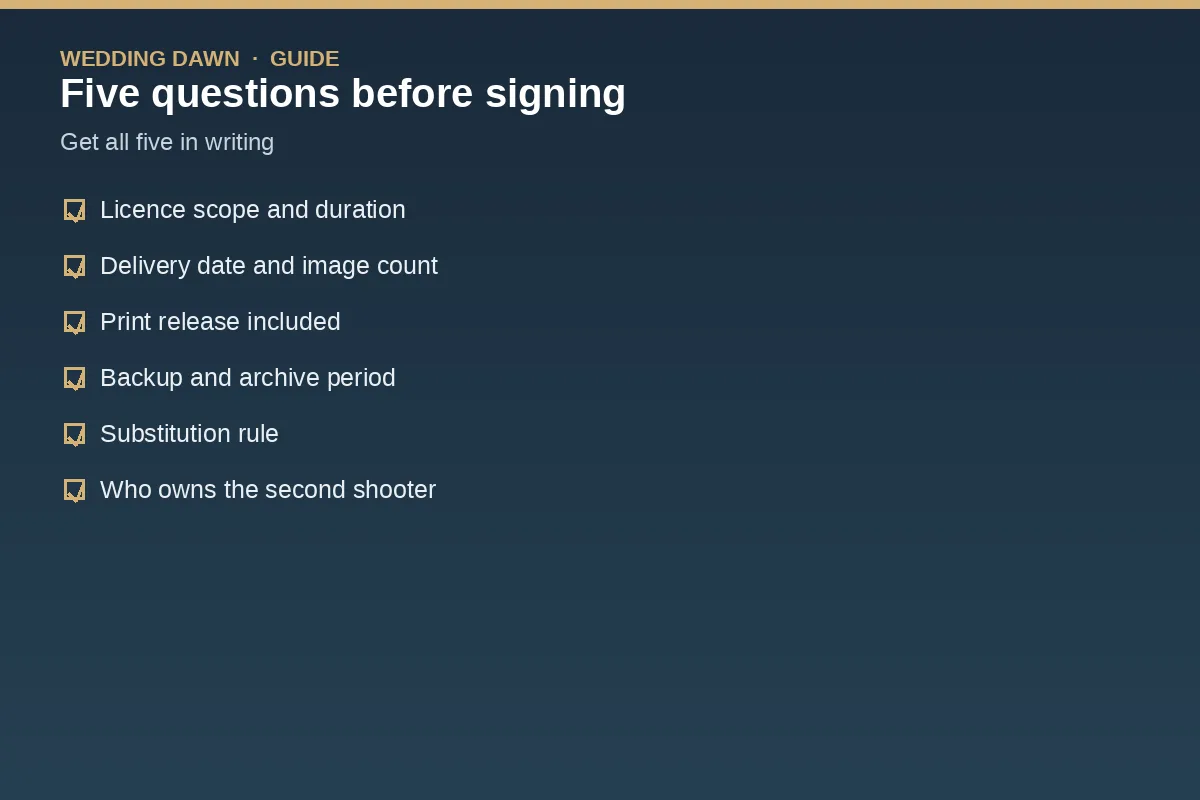
Negotiate the five things that matter: the license scope and duration, the delivery date and image count, the print release, the backup and archive commitment, and the substitution rule. Ask for those five in one page. If the contract is long, ask the photographer to mark the clauses that answer them.
Do not negotiate only on price. A cheaper photographer with a narrow license and no archive may cost more in the long run than a slightly more expensive one with clear terms. The contract is part of the product; read it as carefully as you read the portfolio.
Red flags
Be careful when a contract promises full copyright but excludes the files you need, when the delivery date has no consequence, when the license expires without explanation, when the photographer refuses to name a backup, or when the model release is presented as non-negotiable after you have paid a deposit. These are not necessarily scams; they are signs that the terms have not been thought through.
A good photographer will answer these questions without offense. If a question about copyright makes the conversation difficult before the wedding, imagine the conversation after it. The contract should make the relationship easier, not harder.
You do not need to become a lawyer to book a wedding photographer. You need five answers in writing: what you may do with the images, when you get them, how many, how long they are archived, and who shoots if the named photographer cannot. Get those, and the rest is detail.
Step by step
Ask for the license in plain language
What you may print, post, share and sell, for how long, and whether credit is required. Get it in writing.
Separate print release from copyright
A print release covers personal printing, not ownership or resale. Decide which one you actually need.
Fix the delivery terms
Image count as a range, delivery date, preview timing, and what edited means. Ask what happens if the date slips.
Confirm backup and substitution
How long files are archived, where, and who shoots if the named photographer cannot. Put both in the contract.
Download and back up in month one
Full-resolution gallery to two locations you control. Do not rely on the photographer's cloud as your archive.
Quick checklist
- License scope written: print, share, post, sell.
- License duration and territory stated.
- Credit requirement stated or waived.
- Print release included for personal printing.
- Delivery date and image count as a range.
- Definition of edited written down.
- Preview timeline and late-delivery consequence.
- Backup and archive period in the contract.
- Substitution rule and named backup photographer.
- Second shooter ownership clause.
- Model release limits agreed, including children.
- Full gallery downloaded to two personal drives.
FAQ
Do we own our wedding photos?
Usually not the copyright. In the United States the photographer owns it unless the contract transfers it. You typically receive a license to print and share for personal use. If ownership matters to you, negotiate a transfer in writing before signing, and expect a higher price.
What is a print release?
A document that allows you to print the images, usually for personal use. It tells a lab you have permission. It does not make you the copyright owner and usually does not allow resale or commercial use.
Can we get the RAW files?
Ask early; many photographers refuse, and that is normal. RAW files are unfinished sensor data and part of the editing process. If you need them for archiving, ask instead for full-resolution edited JPEGs and a written backup commitment.
How long should delivery take?
A common range is six to eight weeks for the full gallery, with a preview within one week. Album design can take another two to four months. Get the dates and the consequence for a late delivery in the contract, not just in an email.
Can the photographer post our photos?
Only if the contract allows it, and you can negotiate limits. Ask for a model release you can review, with options to exclude children, identifiable guests, paid advertising, or all public use. Put your choice in writing before the wedding.
Sources
- U.S. Copyright Office — copyright basics Ownership, transfer and registration basics; checked 2026-11.
- FTC Consumer Advice — shopping for a wedding or event Contracts, deposits and cancellation terms; checked 2026-11.
- U.S. Copyright Office — fair use index Background on permitted uses and limits; checked 2026-11.