Wedding Permits for Parks and Public Land
A wedding in a public park, on a beach, at a lighthouse or in a historic courtyard usually needs a permit, and the permit comes from the agency that manages the land rather than from the town where it sits. The rules are dull reading, and they decide whether the ceremony happens at all, so treat them as part of choosing a venue rather than paperwork to fix later.
Which locations actually require one
A private venue handles its own compliance and hands you a contract. Public land works differently: in the agency's eyes you are the event organizer, and the agency answers to everyone else who uses the same space. Any of the following almost always triggers an application:
- A reserved lawn, pavilion or stretch of beach that you want to yourselves, even for thirty minutes.
- Anything you build or bring: arch, chairs, aisle runner, tent, dance floor, generator, sound system.
- A gathering large enough that chairs and a table would be expected.
- Alcohol, catered food, amplified music, or a paid photographer setting up lights and tripods as a production.
- A street, sidewalk or plaza closure, or a procession that walks from one public place to another.
Small ceremony-only weddings with ten guests and no equipment sometimes fit under an informal-gathering rule. Sometimes is doing a lot of work in that sentence, so ask the park office for the specific headcount and equipment threshold in writing before you print invitations.
What the application is really asking
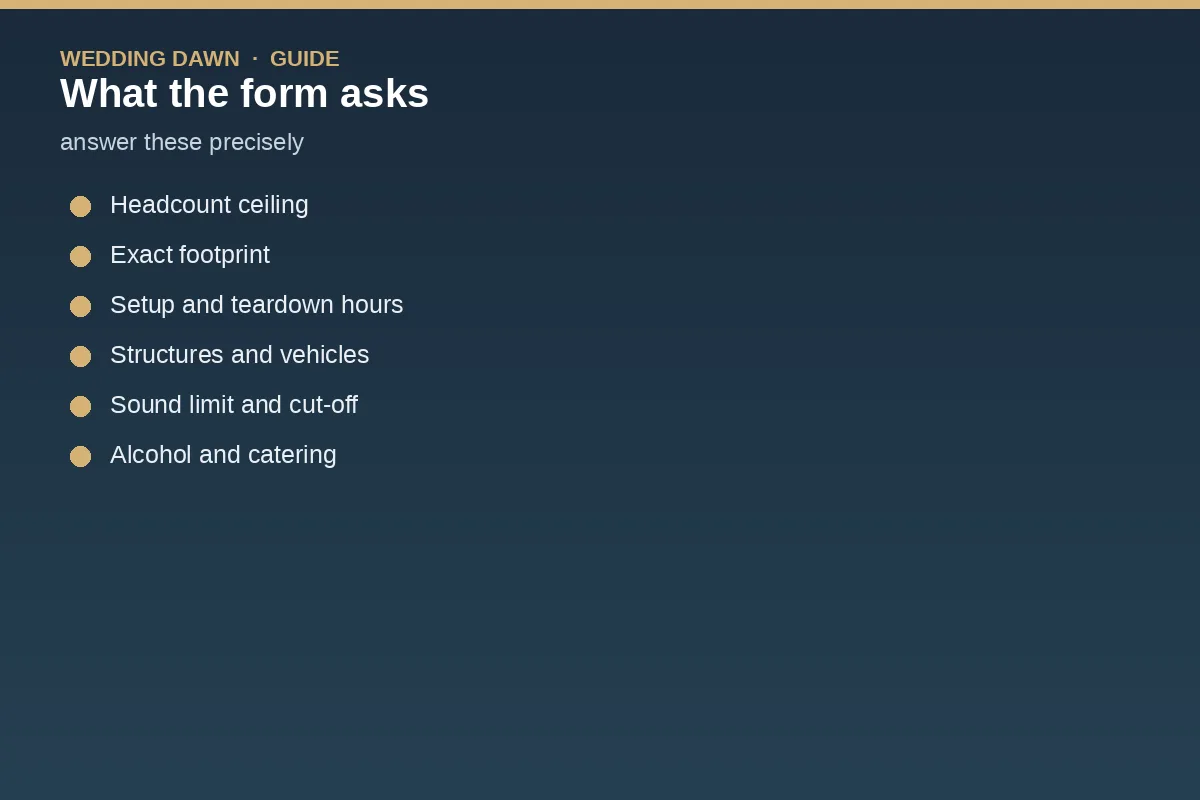
Most permit forms look bureaucratic and are in fact a risk questionnaire. Answer these six points precisely and the rest is administration:
- Headcount, counting guests, vendors and the officiant, with a number you will not exceed. Attendance creep is the most common reason a permit gets pulled on the day.
- Exact footprint: which lawn, which parking bays, which section of sand, and whether the area needs fencing or signs.
- Hours including setup and teardown. A crew arriving at six in the morning to build an arch is an hour that has to be on the form.
- Structures and vehicles: tents, trailers, food trucks, generators, portable toilets.
- Sound: whether you will amplify, at what level, and until when. Music in a park near housing usually has to stop well before the park closes.
- Alcohol and food: who serves, whether they hold a license, and who carries the liability.
Attach a one-page site plan showing the ceremony area, guest seating, vendor vehicle parking and the nearest restrooms. Reviewers approve drawings faster than paragraphs, and the drawing doubles as your own run sheet on the day.
A timeline that survives a busy season
Application windows run from about two weeks to a year, and peak wedding season is exactly when staff are slowest to reply. Work backwards from the date:
- Twelve months out, shortlist three public sites and read each agency's special-event rules before you fall in love with a view.
- Nine to twelve months out, apply for anything involving a closure, a tent or more than roughly seventy-five guests.
- Six months out, apply for a standard park or beach ceremony, and ask for the reviewer's name and a file number.
- Ninety days out, confirm the insurance certificate, vendor licenses and the headcount range.
- Thirty days out, reconfirm arrival times and get the approval letter plus a day-of contact in writing.
- One week out, print the permit and the approval email. Carry both, because the ranger on duty may not be the person who issued it.
Fees, insurance and the certificate nobody plans for
Expect three separate costs rather than one: an application fee, a use fee that may scale with headcount or hours, and a refundable damage deposit. Large or commercial events can also be billed for staff time, meaning rangers, parking control and sanitation at an hourly rate published in the fee schedule.
The item that stops more weddings than any other is the certificate of insurance. Many agencies ask for general liability cover of one to two million dollars with the agency named as additional insured, supplied as a certificate from your insurer or your event policy. Venue and vendor policies sometimes include this and sometimes miss by a line. Send the draft certificate to the permit office for checking as soon as you have it, because a rejected certificate two days before the wedding is a real crisis and an entirely avoidable one.
Ask what the permit does not include. A park permit is not a liquor license, not a health permit for catering and not permission to close the road outside. Those are separate applications at separate offices, and a caterer usually handles only its own.
Rules that turn into fines
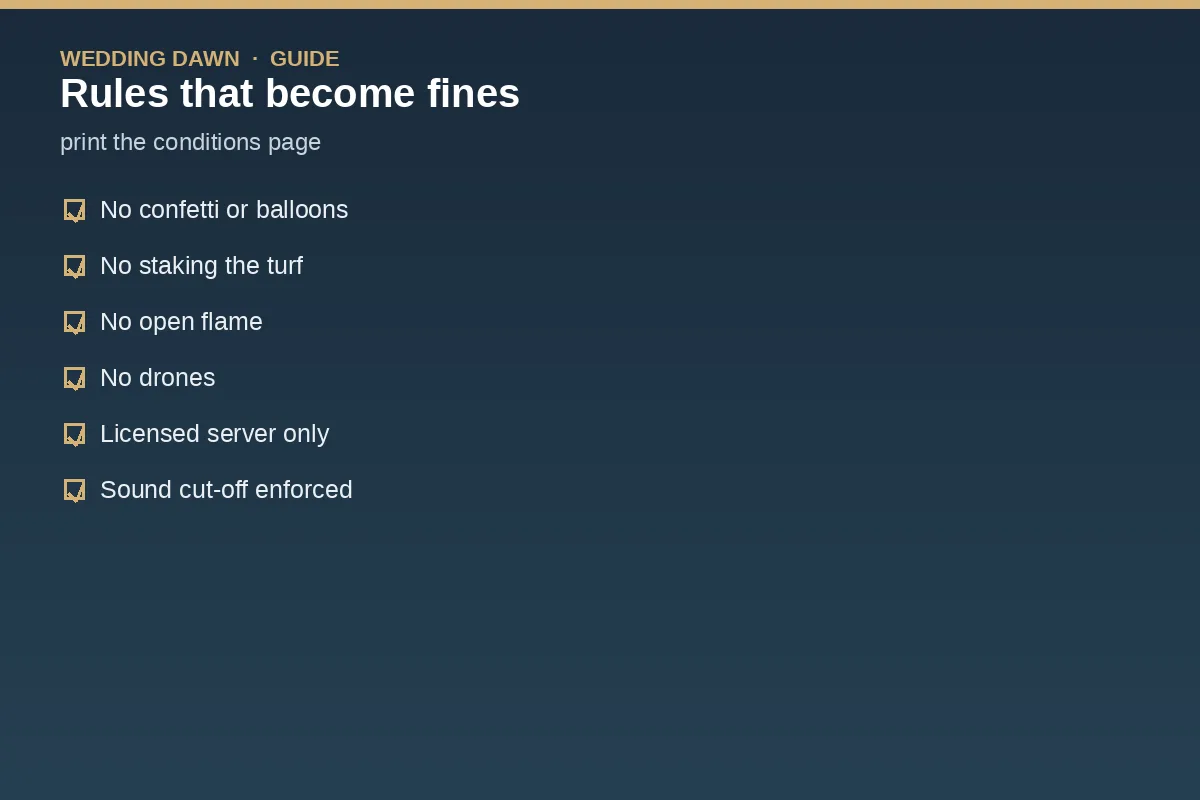
Permit conditions are where the money sits. These are the clauses that most often cost couples a deposit or end a party early:
- Confetti, rice, glitter, balloons and sky lanterns, banned on most public land because nobody can clean them up. Bubbles and dried petals are often tolerated, but ask.
- Staking anything into turf or dunes. Use weighted bases, and check whether chairs must sit on mats.
- Open flame: candles, torches, fire bowls, sparklers. Coastal and forest sites ban them outright in dry months.
- Drones. A park permit is not airspace permission, and many agencies prohibit launches from their land whatever the aviation regulator allows.
- Alcohol without the required license and a licensed server, including a self-serve cooler.
- Amplification past the stated hour, or a DJ who treats the limit as a suggestion. The fine goes to the permit holder, which is you.
- Vendors arriving without insurance or business licenses, and vehicles parked outside the approved area.
On the day, nominate one person who is not the couple to hold the permit, the vendor list and the ranger's phone number. That person also enforces the sound cut-off and the cleanup, so neither conversation lands on someone holding a bouquet.
When the answer is no, or late
Agencies refuse for reasons that have nothing to do with you: turf restoration, nesting season, a marathon, construction or a staffing gap. Ask which condition failed and whether a smaller footprint, an earlier finish or a different month would pass. A ten-guest ceremony at ten in the morning is a different application from a reception for a hundred and twenty with a tent.
Keep a backup venue whose permit path you have already checked, and do not pay a private venue deposit until the public-site approval is in writing. If approval arrives late, remember that invitations, catering minimums and rental deliveries all key off the same date. A permit that appears three weeks before the wedding is not a rescue, it is a reshuffle.
Public land is not a free venue
The fee is small next to a private venue, which is why public sites look like a bargain. The real cost is attention: applications, insurance wording, site plans, arrival windows and cleanup. Budget about a day of admin per application, and treat the approval letter as the moment the venue is actually booked. Everything before that is a proposal.
Keep the paperwork on site
Print the approved permit, the site plan and the conditions, and give a copy to whoever will be on site first. Rangers and venue staff ask for documents at the gate, not by email, and mobile signal is often weak on public land. Note the office hours and the after-hours number on the same sheet, plus the name of the person who approved your application. If a condition changes, ask for the update in writing before you print the final version.
Five steps from view to approval
Find the agency that manages the land
City, county, state, federal and historic-site land all have separate permit offices, and the town hall cannot approve land it does not manage. Start on the site's own visitor page and follow the permits link.
Read the special-event page and fee schedule
Download the application, the fee schedule and the conditions. Note the application window, the insurance minimum and the amplification cut-off before you fix a date.
Draw a one-page site plan
Mark the ceremony area, seating, vendor parking, restrooms and the accessible route, then add an arrival and departure time for each supplier.
Get the insurance certificate checked early
Ask your insurer or event policy for the agency's wording, send the draft to the permit office and fix the gaps while there is still time to fix them.
Submit, then confirm in writing
Keep the file number, ask for the reviewer's email, and collect the approval letter plus a day-of contact at least a month before the wedding.
Permit application checklist
- Managing agency identified: city, county, state, federal or historic site
- Application window and deadline confirmed for your date
- Fee schedule read: application fee, use fee, deposit, staff charges
- Headcount ceiling set and shared with every vendor
- Setup and teardown hours entered on the form
- Structures and vehicles listed, including generator and toilets
- Sound limit and cut-off hour written down
- Alcohol license and licensed server confirmed separately
- Certificate of insurance naming the agency as additional insured
- One-page site plan attached
- Vendor licenses and insurance collected
- Approval letter and file number saved offline
- Ranger or day-of contact number in the run sheet
- Cleanup plan and banned-items list briefed to the wedding party
Frequently asked questions
Do we need a permit for a small ceremony in a public park?
Often yes, and the threshold is lower than people expect: a reserved lawn, chairs, an arch or a photographer's lighting rig can all count. Some agencies allow informal gatherings below a stated headcount with no equipment, so ask the park office for that number in writing instead of assuming it covers you.
How far in advance should we apply?
Six months is a workable default for a standard park or beach ceremony. Anything with a road closure, a tent or more than about seventy-five guests usually needs nine to twelve months. Applications are generally processed in the order received, and peak season is the worst time to be late.
Our venue says it already has a permit. Does that cover us?
Only if the permit names the event and the date and your setup matches what was approved. Ask for a copy. A venue's annual permit often excludes tents, amplified music and outside caterers, which are precisely the things a wedding adds.
Is a permit needed for wedding photos only?
Possibly. Many agencies require a commercial photography or filming permit for paid shoots with tripods, lights or a crew, even with no guests present. A phone and an officiant usually do not count. The filming rules sit on a different page from the wedding rules.
Can we serve alcohol in a public park?
Only where the rules allow it, and almost never without a licensed server and the required insurance. Some agencies ban alcohol outright, others permit beer and wine under a caterer's license. A park permit is not a liquor license, and a self-serve cooler is the detail most often written into citations.
What happens if it rains?
Ask before you sign. Most permits include no covered backup, and putting up a tent may need a separate structure approval. Check whether the permit allows rescheduling, whether the fee transfers and whether you can hold a rain date on the same site, and get the answer in the approval email rather than on the phone.
See all frequently asked questions →
Sources
- U.S. National Park Service Special use permits are handled park by park; each park publishes its own application, fee and conditions. Checked 2026-11.
- NYC Parks Example of a city park system with separate special-event, filming and amplification rules and published fee schedules. Checked 2026-11.
- U.S. Bureau of Land Management Special recreation permits for organized events on federal land, including insurance and bonding requirements. Checked 2026-11.