Wedding Hair Trial: What to Test Before the Day
A hair trial is usually booked as a beauty appointment and treated as a luxury. In practice it is the only rehearsal you get for the first two hours of the wedding morning: the hour, the light, the accessories, the nerves and the person holding the pins. Couples who skip it do not save money; they move the experiment to the one day it cannot fail.
The goal is not to find a pretty picture. It is to answer four questions with evidence: does the shape hold for ten hours, does it survive wind and humidity, does it work with the veil and the neckline, and can your stylist reproduce it at seven in the morning with a room full of people? Everything below serves those four questions.
Book six to eight weeks out, at the hour of the wedding
Six to eight weeks leaves room to change stylist, adjust a cut or fix a color that photographs badly. Book the trial for the same hour as the wedding morning. Hair behaves differently at 7 a.m. than at 2 p.m.: it is flatter, the scalp is tender, and you have not yet eaten. A style that looks effortless at a noon trial may collapse before the ceremony if it was built on freshly washed, bouncy hair.
Wash your hair the night before the trial, not the morning of, and tell the stylist exactly what you did. Many brides arrive with hair their stylist has never seen, styled with products the stylist did not choose. The trial is where you find out that a smoothing treatment, a recent bleach or a keratin service changes how pins grip.
Bring the real accessories, not photographs of them
Bring the veil, the comb, the hairpiece, the earrings and the necklace. Photographs of a veil do not show weight or length, and a comb that sits badly will hurt by the second hour. If the dress is already fitted, bring it or at least a photo of the back and the neckline; a strapless or low-back dress changes where volume can sit without competing with the fabric.
Ask the stylist to attach the veil during the trial, not after it. The attachment point determines whether the style can be taken down for the reception, and whether the veil pulls the updo forward during photographs. If you plan a second look, test the take-down as well: some styles leave a crease that no amount of brushing fixes.
Test the load, not only the look
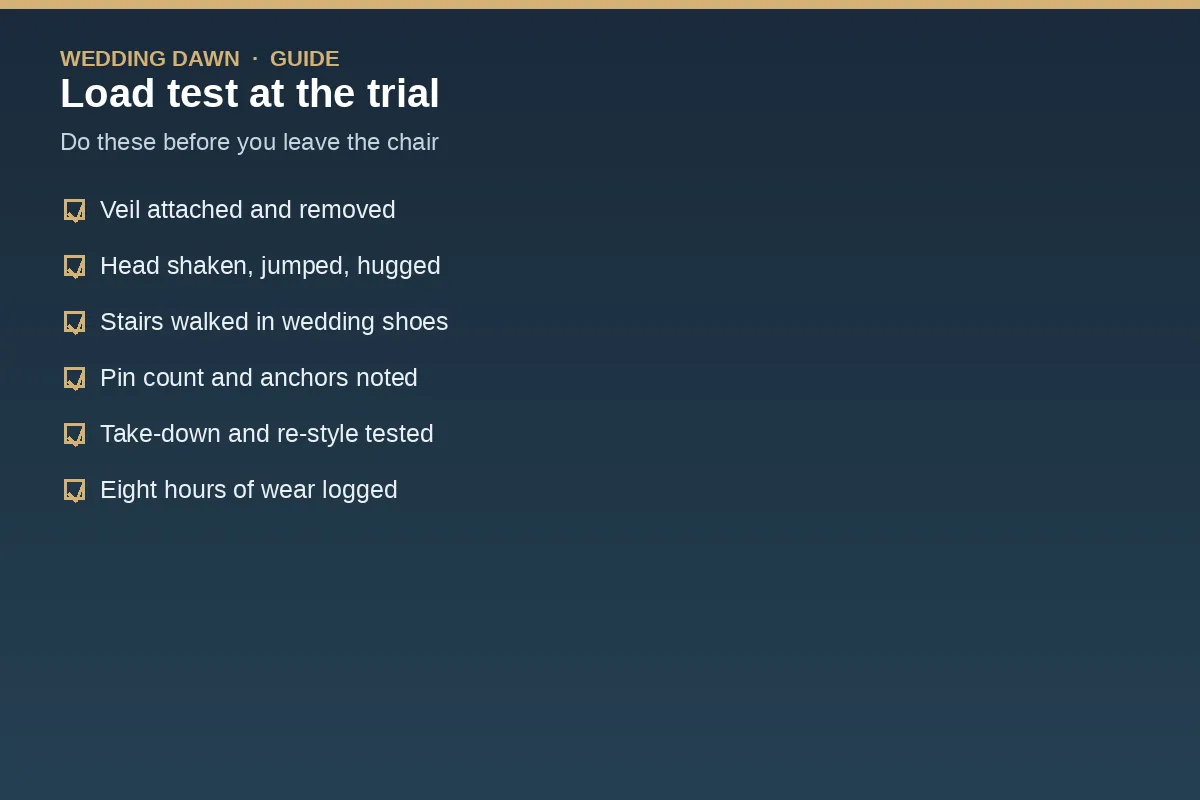
A wedding hairstyle is a structure under load. A cathedral veil pulls backward, extensions add weight at the sides, and a packed dance floor adds heat and movement. At the trial, shake your head firmly, jump once, hug someone and walk up and down stairs. If a pin digs in, it will dig in for twelve hours, and a headache by cocktail hour is guaranteed.
Ask how many pins the style uses and where the anchor points are. Fine hair needs texture and a firmer base; thick hair needs sectioning and more pins than it looks. Clip-in extensions need a secure anchor row, and tape-ins need to be installed days before, not the morning of. None of this is visible in a photograph, which is exactly why it belongs in the trial.
Match the hair to the dress and to the light
Daylight flattens volume and shows every stray pin; candlelight warms the color and softens the shape; camera flash finds shine and scalp. Ask for photographs in daylight, indoors and with flash. A style that reads beautifully in a mirror can look flat in wide shots, and a style with too much height can dominate close portraits.
The neckline decides more than the mood board. A high collar wants hair away from the face; an open back wants a low chignon or a loose wave that covers the shoulder blades; a strapless bodice needs volume placed where it does not fight the dress. Bring the dress, or bring the person who has seen it on you.
The humidity and wind test
If the wedding is outdoors or in a humid climate, the trial must include a humidity test. Walk outside for twenty minutes, then look at the hairline, the curls and the crown. Ask what the stylist uses for humidity: an anti-humectant, a texture spray, a light serum. More product is not the answer; the wrong product makes hair heavy and the curl drop faster.
Wind is the other test. Face-framing pieces should be secured or cut to fall back into place. If the ceremony is on a beach or a rooftop, ask for a style that can be adjusted with one hand and a pin, and carry two spare pins in the same color as your hair. A style that needs constant touching will look tired in every candid.
Photograph it from four angles, then live in it
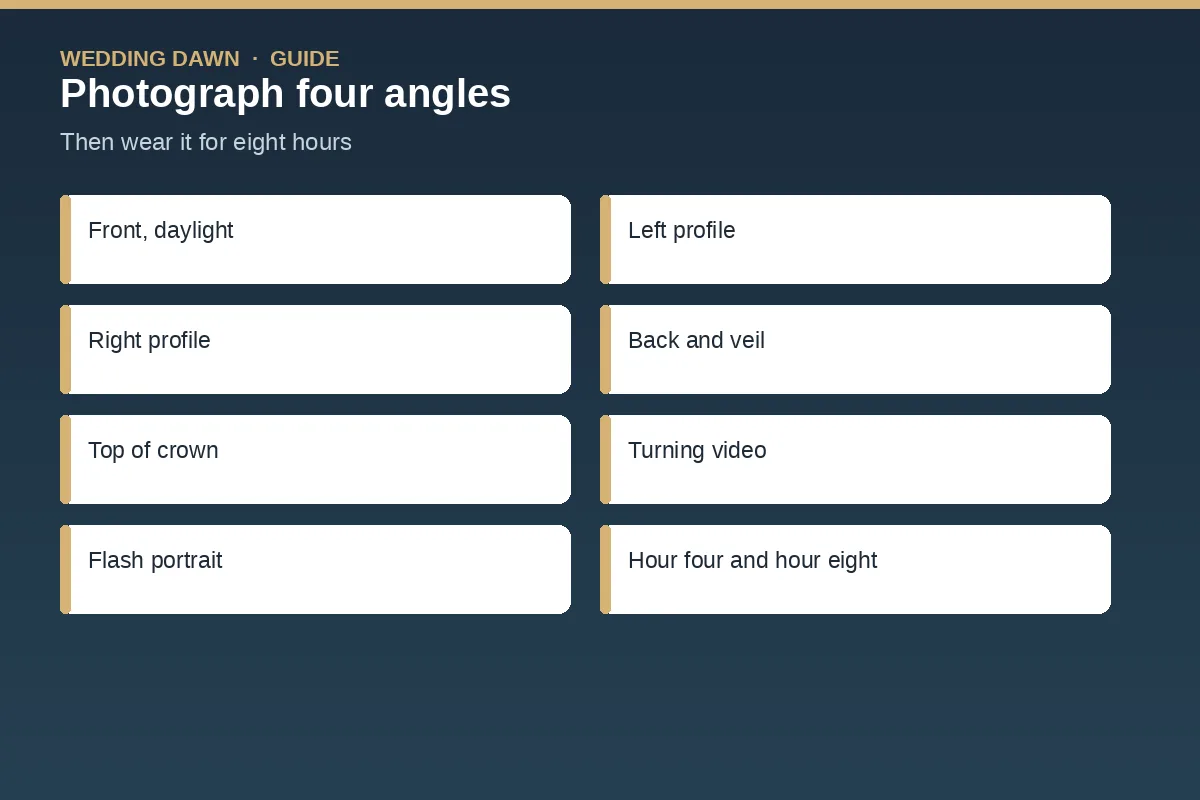
Take photographs from the front, both sides, the back and the top, plus a short video of you turning your head. Then leave the style in. Run errands, eat dinner, sit in a car, and check the mirror at hour four and hour eight. The fall is information: where it loosens first tells the stylist where to reinforce.
Write down what you see, not what you feel. The left side dropped by four in the afternoon is useful; it felt wrong is not. If you can, book the trial on a day with ordinary weather rather than a crisp, dry afternoon that flatters every style.
Talk in shapes, not in names
Words like soft waves, clean bun and romantic mean different things to different people. Bring three references with hair similar to yours, and point at the part you like in each: the height at the crown, the width at the temple, the finish at the ends. Ask the stylist to name the final look in one sentence and write that sentence into the booking.
Agree on the details that decide the day: side part or middle, face-framing or slicked back, volume at the crown, whether the ends are tucked, and how the style behaves when you take the veil out. If your stylist cannot describe the shape without a photo, the style is not yet decided.
What it costs, and what to ask before you pay
Trials are often priced separately, roughly 75 to 250 dollars depending on the city and the stylist, and some salons credit the fee toward the wedding day. Ask about travel, parking, an assistant for a large party, and whether the person at the trial is the person who will arrive on the day. A trial with the junior stylist and a wedding-day senior is a different service.
Get the day-of schedule in writing: arrival time, minutes per person, who is styled first, and the overtime rate. If you have six bridesmaids and a 45-minute ceremony slot, the math has to work before you pay a deposit. The trial is the moment to discover that the timeline needs a second stylist, not the morning of.
Red flags at the trial
A stylist who does not ask about bleach, keratin, extensions or previous color is guessing. One who will not let you photograph the result is protecting the wrong thing. One who builds a style that takes ninety minutes when the schedule allows forty-five is selling you a plan that cannot be executed. And one who ignores your hair texture in favor of a reference photo will fight your hair on the day.
Other warnings: heat tools used without a protectant, a style so tight that your forehead lifts, no answer for humidity, and no plan for the veil. None of these are aesthetic disagreements. They are execution risks, and the trial is the cheapest place to find them.
Turn the trial into a day-of plan
After the trial, write a one-page recipe: products used, pin count, the order of the morning, who holds the veil, the backup pins, the blotting papers and the small hairspray that travels with you. Give the stylist a photo card and keep one in your bag. The recipe is what makes the result repeatable by a different person if the original stylist is ill.
Build the morning backward from the first look. If photographs start at two in the afternoon, hair should be finished by quarter past one, which means the bride starts at half past ten and the party runs in parallel, not in sequence. Add fifteen minutes for the veil and ten for the bathroom. A trial that does not produce a timeline has only produced a hairstyle.
If you hate it
Say it at the trial. Ask for one change at a time: less height, a lower part, a softer edge. Changing three variables at once makes it impossible to know what worked. If the second attempt still fails, change stylists; a second trial costs far less than a day-of rescue, and far less than disliking every photograph.
Do not confuse discomfort with style. A headache, a tender scalp or a style you cannot turn your head in is a failure, not a sacrifice. You will wear this for ten hours, through tears, dancing and probably rain. Comfort is part of the brief.
The trial is cheap insurance on the one morning you cannot redo. Book it early, bring the real accessories, test the load, photograph the result and leave it in until it falls. Then write the plan down. The wedding day should be execution, not experiment.
Step by step
Book at the wedding-morning hour
Six to eight weeks out, same time of day as the wedding. Wash hair the night before and tell the stylist about color, bleach or smoothing treatments.
Bring the real accessories
Veil, comb, hairpiece, earrings, necklace and the dress or photos of its back and neckline. Test the veil on and off.
Test the structure under load
Shake your head, jump once, hug someone, climb stairs. Ask for pin count and anchor points; check extensions and take-down.
Photograph four angles and wear it out
Front, sides, back, top plus a turning video. Keep it in for eight hours and note where it falls first.
Write the recipe and timeline
Products, pins, order of the morning, veil handler, backup pins. Build backward from the first look and put it in the contract.
Quick checklist
- Trial booked 6–8 weeks out, at the wedding-morning hour.
- Hair washed the night before; stylist told about bleach, color, keratin, extensions.
- Veil, comb, hairpiece, earrings and necklace brought in person.
- Dress or photos of the back and neckline on hand.
- Veil attached and removed during the trial.
- Style shaken, jumped, hugged and stair-tested.
- Pin count and anchor points written down.
- Photos from front, both sides, back and top, plus a turning video.
- Style worn for at least eight hours; fall points noted.
- Humidity and wind test done outdoors for 20 minutes.
- One-page recipe written: products, pins, order, backup pins.
- Day-of timeline and overtime rate in the contract.
FAQ
When should I book a hair trial?
Six to eight weeks before the wedding is the practical window. It is late enough that your cut and color are close to final, and early enough to change stylist or adjust the plan without panic. If you are growing out a cut or testing extensions, start eight to ten weeks out.
How much does a wedding hair trial cost?
In the United States, most trials run about 75 to 250 dollars depending on the city, the stylist's level and whether travel is included. Some salons credit the trial fee toward the wedding-day service; ask before booking. A second trial with a different stylist is usually cheaper than a day-of rescue.
Should I wash my hair before the trial?
Wash it the night before and skip heavy conditioner at the roots. Day-old hair holds pins better than freshly washed hair, and the stylist needs to see the texture you will actually have on the wedding morning. Tell them exactly what you used, including oils, serums or leave-in treatments.
Do I need a trial if I want my hair down?
Yes, especially for down styles. Loose waves and half-up looks are the first to fall, and the trial is where you learn how they behave with the veil, the dress and the weather. A down style still needs a plan for the ceremony, the photographs and the reception.
What if I want a different style on the wedding day?
Change it at the trial, not afterwards. Ask for one variable at a time so you can tell what worked. If you still want a second look, test the take-down and the quick re-style during the trial; some updos leave a crease that cannot be brushed out in a bathroom mirror.
Sources
- FTC Consumer Advice — shopping for a wedding or event Deposits, cancellation terms and event contracts; checked 2026-11.
- American Academy of Dermatology — hair styling tips Heat protection and tight-style guidance used for the comfort section; checked 2026-11.
- U.S. FDA — hair products Hair dye, bleach and product safety background; checked 2026-11.