Wedding Flower Meanings Without the Myth
Flower meanings are the most quoted and least checked part of wedding planning. Most lines of the kind — this bloom stands for eternal love, that one for constancy — come from nineteenth-century gift books or from twentieth-century shop copy, not from a custom anyone can trace. That does not make them worthless: a short, honest note in the ceremony program is a nice thing to hand a guest. It does mean that a symbol should never be the reason you pay three times as much for a stem that will droop by dessert. This guide separates three things that get mixed together — documented symbolism, seasonal availability, and how a flower actually behaves in a bouquet in a warm room.
What the historical record actually supports
The language of flowers was a publishing fashion before it was an inherited code. It took off in Europe in the early 1800s, when small dictionaries assigned a meaning to each plant, and it was profitable enough that rival publishers issued competing editions. Those editions disagreed. The same flower could mean constancy in one book and farewell in another, and some meanings reversed depending on whether the stem was presented upright or upside down. When a florist or a blog gives you a confident meaning, the fair question is which dictionary it came from. Treat the meaning as decoration for the story you tell, not as a constraint on what you buy.
A handful of associations are older and better attested, and those are the ones worth saying out loud. Rosemary has been carried at funerals and weddings for centuries as a token of remembrance, and it appears in that role in Shakespeare. Myrtle has been in British royal bridal bouquets since the nineteenth century, which is why it still turns up in royal wedding coverage. Olive, wheat and fig appear in Mediterranean wedding custom as wishes for abundance rather than as sentimental messages. Against that, most of what is sold as ancient wisdom is modern copywriting: lavender for calm, succulents for resilience, eucalyptus for healing. Both kinds can go in the program, but only the first kind should be described as tradition.
Pick by season, not by symbol
The calendar is the strongest lever you have over both price and quality, and it is the lever couples ignore most often. Peonies in late spring are abundant, cheap and superb; the same stems in December are flown in, expensive, and often tight or bruised on arrival. Ask your florist for a written list of what is at its peak in your month and your growing region, then design inside that list. Three or four generous seasonal stems usually read as more expensive than a mixed dozen of imported ones, because the material is larger, fresher and better colored. If a flower you love is out of season you have three honest options: pay the import premium knowingly, substitute something with the same shape and weight, or use dried material for that one element.
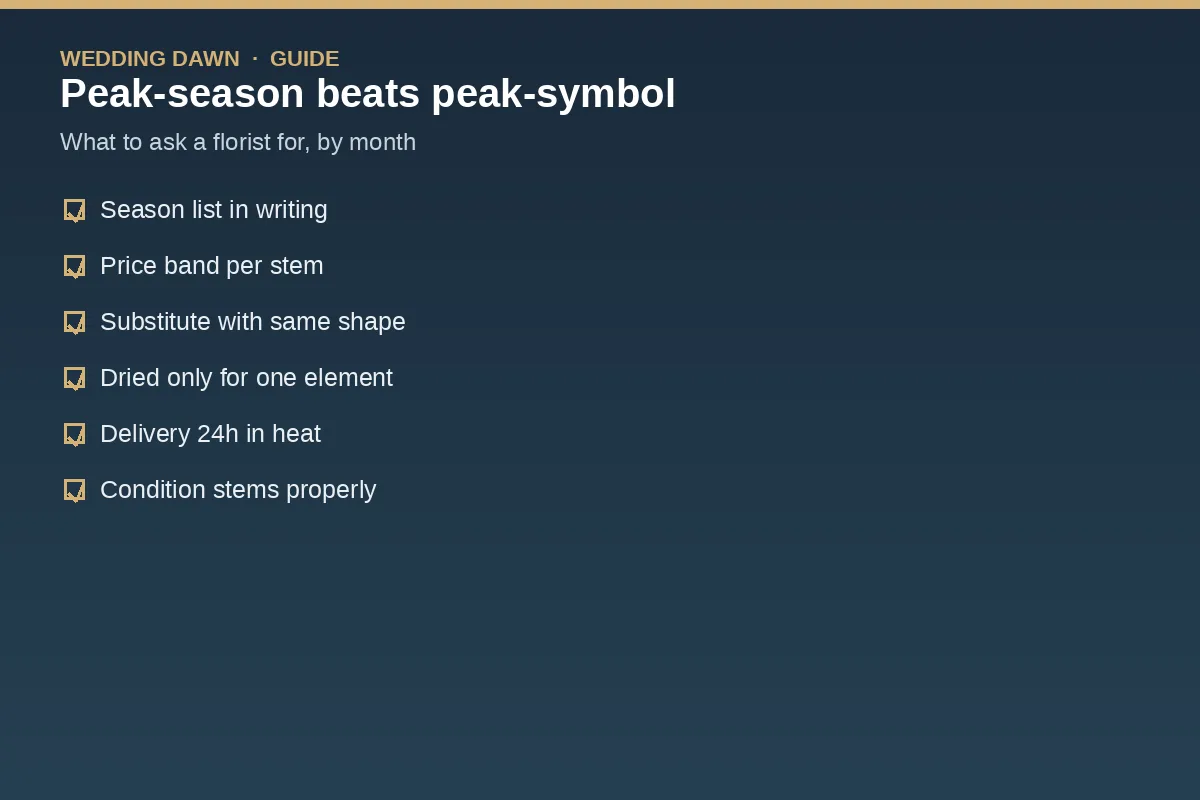
Season also sets vase life, which is the part guests actually notice. Cool-weather stems such as ranunculus, anemone and most garden roses hold longer in a cool room, while summer flowers open fast and shatter. If your date falls in a warm month, ask for delivery 24 hours before rather than 48, keep the room below about 22°C overnight if the venue allows it, and make sure the florist conditions the stems properly: strip the lower leaves, cut on an angle, clean water, and a cool dark place for the first few hours. A bouquet that was conditioned well looks a day younger on the morning of the wedding.
Availability also changes the shape of what you can ask for. A florist working in season can build a loose, garden-style arrangement because the stems are long and varied. Out of season, the same brief gets rebuilt from short imported stems and starts to look tight and uniform. If every photograph you saved depends on a particular silhouette, check that the silhouette is achievable in your month before you fall in love with the reference.
Scent is a venue decision
Scent is the one property of flowers that acts on guests physically, so it should be planned by room rather than by bouquet. Lilies, freesia, hyacinth and tuberose carry across a large space, which makes them effective at an entrance or behind the ceremony arch and overpowering on a dinner table. At table height a strong scent competes with the food and can give a sensitive guest a headache before the main course. Put the scented material where people pass and the low-scent material where people sit. Ask the florist to remove lily anthers before installation: the pollen stains fabric badly and does not come out of a pale dress.
Allergies are usually blamed on the wrong plants. The pollen that causes hay fever is mostly wind-borne, from grasses, trees and weeds, not the heavy sticky pollen of showy flowers. That said, a guest with a specific sensitivity will remember your centerpiece, so one line on the RSVP asking about flower allergies costs nothing and occasionally saves a dinner. Cleaner air, fewer lilies at the table and no strongly scented flowers near the food will cover most of it.
Color does more work than any meaning
Guests read color long before they read a card, so the palette is doing most of the emotional work that the symbolism gets credit for. Two colors plus a neutral is the most reliable recipe: a dominant tone, a supporting tone, and green or cream as breathing space. Three works if one of them is close to neutral. Five usually reads as borrowed from five different references. The palette also has to survive the venue's light. A soft peach scheme that looks lovely on a phone can go gray in a marquee at dusk and yellow under warm bulbs. Ask to see a sample in the actual room, at the actual hour, before you approve it.
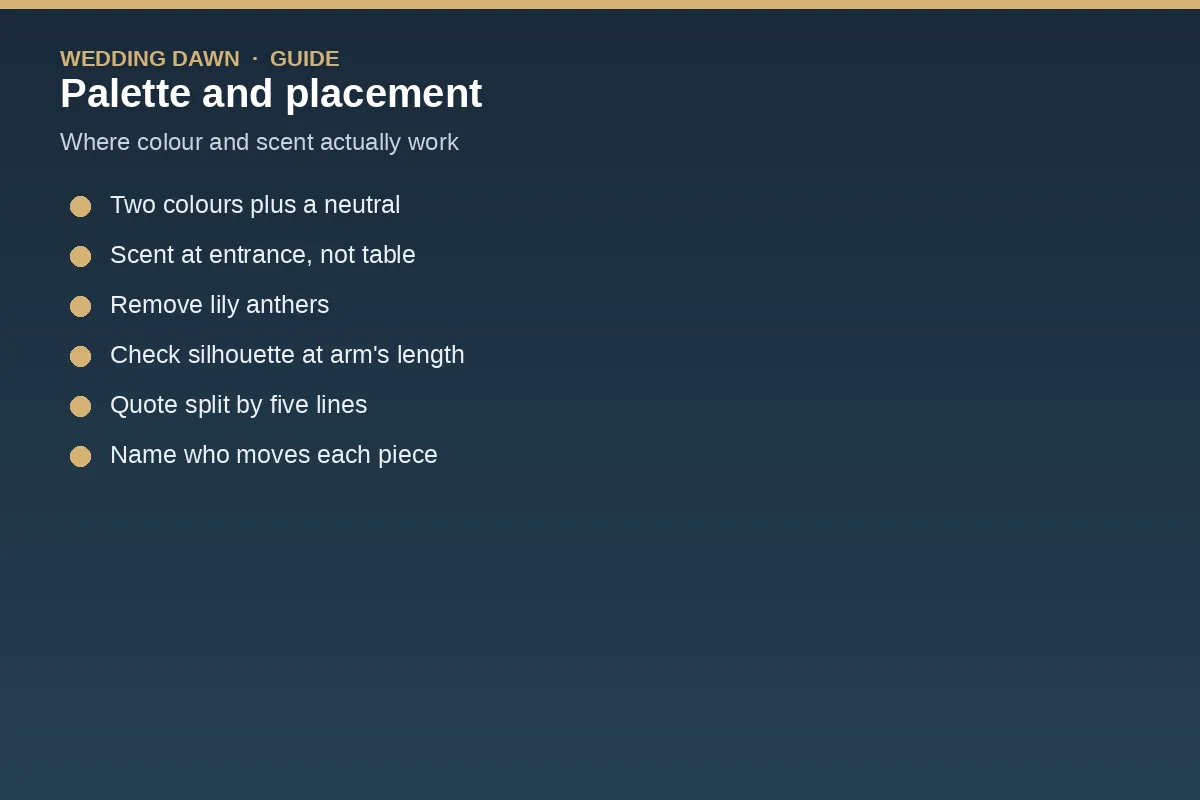
Texture matters as much as hue when everything is photographed in the same light. A single-color bouquet works only if the shapes differ: round roses, spiked delphinium, airy astilbe, a broad leaf. Ask the florist to show you the stems side by side before they are tied, and check the silhouette at arm's length rather than close up, because that is the distance every photograph will use.
Where flower budgets leak
Most flower quotes are built as a price per arrangement, which hides the cost of the work. Ask for a quote split into five lines: stems, labour, delivery, installation and strike. Labour is often a third of the total on a large wedding, and it is the line most likely to move when the plan changes. Installation and breakdown are real costs: someone has to hang the arch, and someone has to come back at midnight. Vessel rental, candles, mechanics and waste removal belong in the quote too. A florist who will not itemise is not necessarily overcharging, but you cannot compare two quotes or trim one sensibly when the numbers arrive as a single figure.
Reuse is the cheapest saving available, and it has to be designed in rather than improvised. Ceremony pieces can move to the reception, aisle flowers can become table flowers, and the bridal bouquet can sit on the head table. Say this in the brief and confirm who moves each item and when, because moving is a paid task rather than a favor, and a plan that depends on a cousin with free hands usually fails. Order a small surplus, five to ten per cent, to cover damaged stems and a dropped buttonhole, and agree in advance what happens to the leftovers: charity, guests, or the bin.
The other leak is quantity without purpose. Count how many arrangements a guest will actually see at once: entrance, ceremony focal point, six to eight tables, bar, cake. Anything beyond that is photographed once and then guarded by nobody. Spending the same money on fewer, larger pieces almost always photographs better than spreading it thin.
Building a bouquet you can defend
A bouquet needs four jobs filled: three to five focal stems that carry the color, a secondary flower that repeats it at a smaller size, a filler that adds air, and one textural element for contrast. The proportions that read best in photographs are roughly one and a half times the width of the person carrying it, with the stems long enough that the flowers sit at hip height rather than at the waist. Hold a mock-up at arm's length in daylight before you commit. If it looks like a ball of one color with no gaps, it will photograph as a ball of one color with no gaps.
- Do not choose a flower for its meaning, then discover it is out of season and triple the price.
- Do not build a five-color palette out of five separate reference photos.
- Do not put lilies or tuberose on a dinner table.
- Do not accept a single-figure quote for a multi-part installation.
- Do not plan reuse without naming who carries each piece and when.
- Do not skip a sample in the venue's own light.
- Do not order the exact count with no surplus for damage.
- Do not let anyone tell you a meaning is ancient without asking which book it came from.
Write one line for each flower in your program explaining why it is there, and be willing to say that the reason is that it was in season and looked right. Guests respond to a specific, honest note far better than to a paragraph of invented symbolism, and the flowers last longer because you chose them for how they behave rather than for what a dictionary once claimed.
Choose wedding flowers in five steps
Set the palette before the flower list
Choose two colors plus a neutral, then look at them in the venue's light at the hour of the event. The palette decides which flowers are acceptable; the flower list should not decide the palette.
Ask for a peak-season list in writing
Request what is at its best in your month and region, with a price band for each stem. Design from that list first and treat everything else as a deliberate exception with a named cost.
Test scent where people will sit
Smell the proposed stems at table height, not in the shop doorway. Move lilies, freesia, hyacinth and tuberose to entrance and ceremony pieces, and keep the tables low-scent.
Get a quote split by cost line
Stems, labour, delivery, installation and strike should be separate numbers. Compare quotes on the labour and install lines, not only on the headline price per arrangement.
Plan reuse and breakdown in the brief
Name each piece that moves, who moves it and at what time, then confirm the strike hour and what happens to leftovers. Unplanned reuse is the most common reason flowers end up in a bin at 9pm.
Flower order checklist
- Palette limited to two colors plus a neutral, approved in the venue's light
- Written peak-season list for your month and region
- Every out-of-season stem has a named price premium or a substitute
- Scent tested at table height, not in the shop
- No lily pollen left on stems that will be near pale fabric
- Quote split into stems, labour, delivery, installation and strike
- Vessel rental, candles and mechanics listed separately
- Reuse plan with named carriers and times
- Surplus of five to ten per cent for damage
- Delivery slot 24 hours before in warm months, 48 in cool
- Conditioning instructions confirmed with the florist
- Written plan for leftover flowers after the event
Frequently asked questions
Do flower meanings have a real historical basis?
A few do. Rosemary as remembrance and myrtle in royal bridal bouquets are documented and old. Most of the rest come from nineteenth-century flower dictionaries that contradicted each other, or from modern shop copy. Use them as a story, not as a purchase criterion.
How much should wedding flowers cost?
There is no fixed percentage, but a common planning range is eight to twelve per cent of the total budget, and labour is often a third of that. Ask for a quote split by line so you can see whether you are paying for stems, work or installation.
Which flowers are cheapest?
Whatever is at peak in your region that month. Carnations, chrysanthemums, alstroemeria and seasonal greenery are usually the most reliable low-cost options, but a local peak-season stem will often beat them on quality per dollar.
Can we use fake flowers to save money?
Yes, if they are used deliberately: a preserved or dried element in one place, or high-quality silk for an installation that has to survive heat. Mixing cheap silk with fresh stems at close range rarely photographs well.
How do we stop flowers wilting before the reception?
Deliver close to the event, condition the stems properly, keep the room cool overnight, and avoid direct sun on the arrangements. In hot weather, ask the florist to deliver 24 hours before rather than 48 and to provide water sources for every piece.
What should we ask the florist before signing?
Ask for the peak-season list, a line-item quote, the installation and strike times, who moves reused pieces, the substitution policy, and what happens to leftover flowers. Get it in writing, including the deposit and cancellation terms.
See all frequently asked questions →
Sources
- Wikipedia — Language of flowers History of nineteenth-century flower dictionaries and their inconsistencies; checked 2026-11.
- Kew — Plants of the World Online Species names and native ranges used when checking seasonal availability; checked 2026-11.
- Royal Horticultural Society — cut flower care Conditioning, vase life and handling guidance for cut stems; checked 2026-11.