Wedding Budget Spreadsheet That Works
A wedding budget spreadsheet fails for the same reason a gym membership does: it is set up in one optimistic afternoon and never opened again. The fix is not a better template. It is a smaller sheet that answers three questions every week: what have we committed, what is still unpaid, and what is left in the category we are about to spend from. Couples who track that way usually discover the same thing around month four — the venue and catering have already consumed half the budget, and the guest list is the only number that can still change the outcome.
This guide shows how to build that sheet from scratch, in the order the decisions arrive: the total you can spend, the categories that deserve their own line, the deposits that must be recorded the day they are paid, and the weekly review that keeps the plan honest. It assumes a spreadsheet app you already own; nothing here needs a paid tool. The examples use US dollars, but the structure works in any currency.
Start with the money you have, not the wedding you want
Most templates begin with a total that reflects an average wedding, then invite you to trim. That is backwards. Start with three numbers you can defend: cash you can spend without borrowing, contributions you have been promised in writing, and a reserve you refuse to touch. Add the first two, subtract the reserve, and you have the planning ceiling. If the ceiling is below the cost of the wedding you have in mind, the honest options are fewer guests, a different season, or a different venue — not a bigger spreadsheet.
- Count only money already saved or committed in writing; verbal promises are not budget.
- Keep a separate emergency reserve of at least 5–10% of the total, outside the wedding categories.
- Write the ceiling in the top cell and freeze the row so every category total is read against it.
Four layers keep the sheet readable
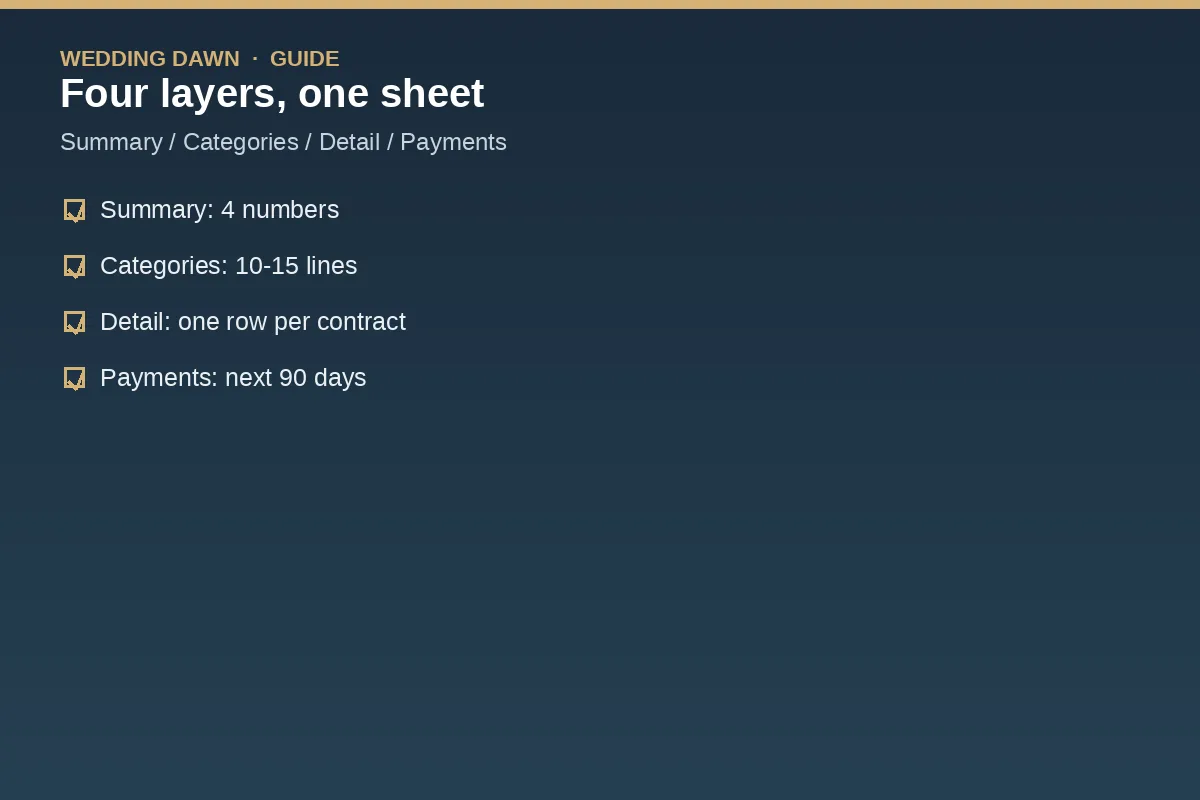
A useful sheet has four layers, and they should live on separate tabs or clearly separated blocks. The summary layer holds the ceiling, the total committed, the total paid, and the remaining balance — four numbers, visible at a glance. The category layer lists ten to fifteen lines: venue, catering, drinks, attire, photography, music, flowers, stationery, transport, rings, beauty, officiant and license, gifts, and a contingency line. The detail layer holds one row per contract or purchase, with date, supplier, amount, deposit, balance due, and due date. The payment layer is a calendar view of every due date in the next ninety days. When someone asks whether you can afford an upgrade, you look at the summary, then the category, then the detail row. You never scroll through a hundred mixed rows to find an answer.
- Summary: ceiling, committed, paid, remaining.
- Categories: fixed lines only, plus contingency; no miscellaneous.
- Detail: one row per contract with deposit, balance, and due date.
- Payments: the next 90 days sorted by due date.
Record every deposit the day you pay it
The most common failure in wedding budgeting is not overspending; it is losing track of what has already been spent. A deposit leaves your account once, but it appears in three places: the supplier contract, your bank statement, and the sheet. If the sheet is updated at the end of the month, two of those will disagree. Enter the payment on the day it happens, with the contract reference and the remaining balance. Photograph or file the receipt in the same action. This takes ninety seconds and prevents the scene where two people each think the other has paid the florist.
- Columns: date paid, supplier, contract total, deposit, balance, due date, method, receipt link.
- Mark a row paid in full only when the balance is zero and the receipt is filed.
- Keep a separate column for refundable versus non-refundable amounts.
Give contingency its own line and defend it
Every realistic wedding has costs that were not in the first plan: a second shuttle, a marriage license fee, service charges, tax, overtime for staff, a replacement for a broken item. A contingency line of 8–12% of the total is not padding; it is the difference between a plan that survives contact with reality and one that needs a loan in the final month. The rule that makes it work is simple: contingency can be spent only by agreement between the two people paying, and every withdrawal is recorded with a reason. At the end of the wedding, whatever remains is the first money back in your pocket.
- Set contingency at 8–12% and keep it away from the fun categories.
- Require both payers to approve any withdrawal.
- Log the reason next to every withdrawal, not just the amount.
Track weekly, in fifteen minutes
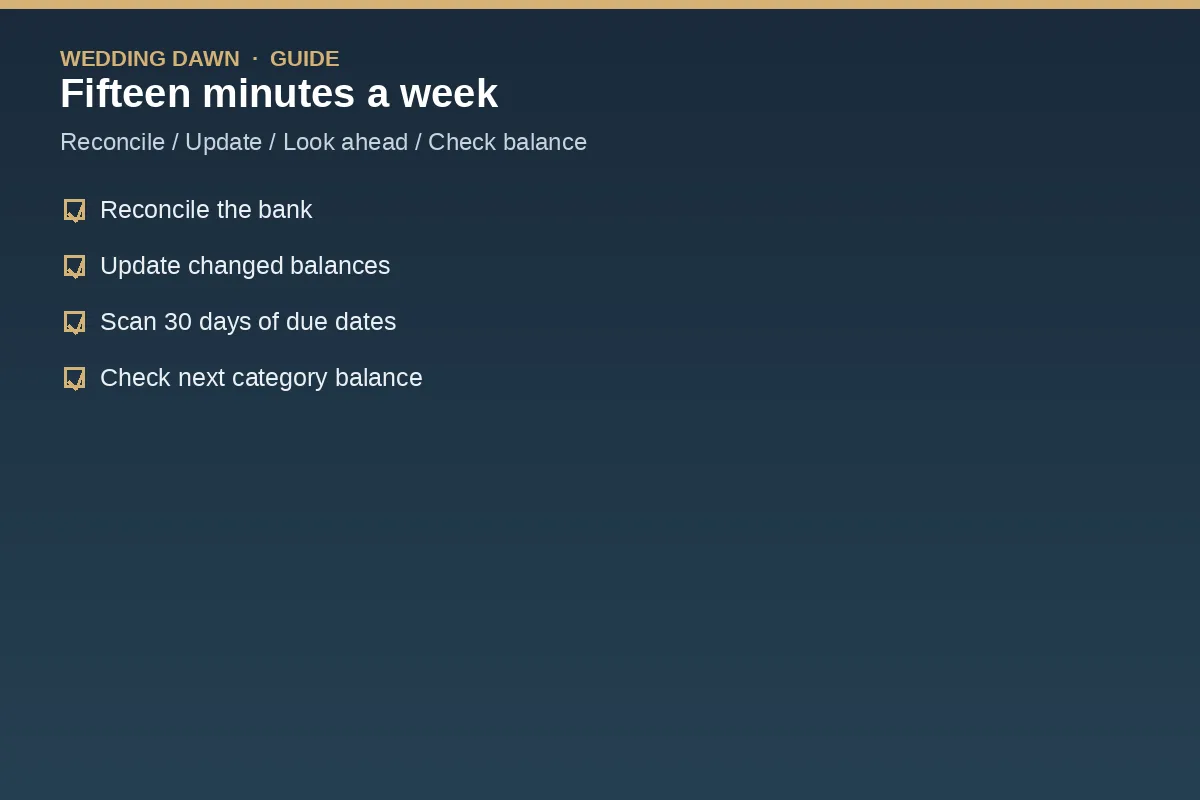
A monthly review is long enough for three due dates to pass unnoticed. A weekly review is short enough to become a habit. Put fifteen minutes in the calendar, open the sheet, and do four things: reconcile the bank account against the payments layer, update any balance that changed, look at the next thirty days of due dates, and check the remaining balance in the category you are about to spend from. The last step is the one that prevents surprises. If the flowers budget is 60% spent and the florist has not yet quoted the centerpieces, the conversation happens now, while there are still options.
- Reconcile payments against the bank statement every week.
- Look thirty days ahead, not just at this week's bills.
- Check the category balance before requesting any new quote.
The lines people forget
Certain costs are missing from almost every first draft. Tax and service charges on catering are often quoted separately and can add a fifth to the line. Delivery, setup, and breakdown fees appear on rental contracts. Staff meals and vendor meals are usually required by venues and count per head. Marriage license fees, officiant travel, and ceremony permits vary by jurisdiction. Alterations can rival the price of the dress. Welcome drinks, morning-after brunch, and tips for the people who actually run the day are real costs, not extras. Add these lines before you compare quotes; a cheaper quote with unlisted fees is not cheaper.
- Tax, service charge, and gratuity on catering and bar.
- Delivery, setup, breakdown, and overtime on rentals.
- Vendor meals and staff meals, priced per head.
- License, officiant travel, and permit fees.
- Alterations, cleaning, and preservation for attire.
- Welcome event, brunch, and tips.
What to do when the total goes over
It will go over; the question is when you notice. Cut in order of pain, not in order of ease. First remove costs that add nothing to the experience: printed menus nobody keeps, a second favor, a bigger cake than the guest count needs. Then renegotiate scope with suppliers you have already booked — fewer hours of photography, a smaller bar package, a shorter shuttle route. Only then change the guest count, because it moves every per-head line at once and is the largest single lever you have. Do not solve an overrun by cutting the contingency line; that is the same as canceling the insurance because the premium is annoying.
- Cut decorative items first, contracted scope second, guest count third.
- Never cut contingency, liability cover, or vendor meals.
- Renegotiate in writing and update the detail row the same day.
A template you can copy in ten minutes
If you are starting from an empty file, build it in this order: one summary block with four numbers, thirteen category rows with a formula summing their detail rows, a detail table with the columns above, and a payment calendar filtered to the next ninety days. Freeze the header row, format every money column to two decimals, and add a single red conditional format for any category over its planned amount. Then stop designing. The sheet is good enough when the four summary numbers are correct and you can answer how much is left for flowers in under ten seconds.
- Ceiling and reserve are written down and agreed.
- Every signed contract has a detail row.
- Every payment is entered the day it is made.
- Contingency is 8–12% and protected.
- One weekly fifteen-minute review is in the calendar.
- Tax, service, delivery, meals, and tips are budgeted.
- The remaining balance per category is checked before each new commitment.
Step by step
Write down three numbers
Cash available, contributions promised in writing, and a reserve you will not touch. Subtract the reserve to get the ceiling.
Build the four layers
Summary, categories, detail rows, and a 90-day payment calendar. Keep them on separate tabs.
Enter contracts as you sign them
One row per supplier with total, deposit, balance, due date, and receipt link.
Protect the contingency line
Set 8–12%, require both payers to approve withdrawals, and log every reason.
Review every week for fifteen minutes
Reconcile the bank, update balances, scan 30 days ahead, and check the next category balance.
Quick checklist
- Ceiling equals saved cash plus written contributions minus reserve.
- Ten to fifteen fixed categories, no miscellaneous line.
- Every contract has a detail row with deposit and balance.
- Payments are entered on the day they are made.
- Contingency is 8–12% and cannot be spent silently.
- A weekly 15-minute review is scheduled.
- Forgotten fees (tax, service, delivery, meals, tips) are included.
FAQ
Do we need a spreadsheet, or is an app enough?
An app is fine if it shows committed, paid, and remaining by category and exports your data. A spreadsheet wins when you want one view across contracts, payments, and a 90-day calendar without subscribing to another service.
How detailed should the categories be?
Ten to fifteen lines is the sweet spot. Fewer hides where money goes; more turns the sheet into bookkeeping. Put small recurring purchases inside a larger line and note them in the detail rows.
Should we include money we expect as gifts?
No. Budget only against money you control before the wedding. Gifts arrive after the bills and vary too much to fund deposits; treat them as recovery, not income.
What percentage should contingency be?
Eight to twelve percent of the total is a practical range for most weddings. Go higher for outdoor venues, peak-season dates, or destination events where change fees are larger.
How do we handle shared payments between two families?
Add a payer column and a paid-by summary. Record each transfer on the day it arrives, and agree in writing which categories each side covers before the first deposit is paid.
Sources
- Consumer Financial Protection Bureau — Managing your money Consumer guidance on budgeting, contracts, and payment records, reviewed 2026-11.
- FTC — Consumer Advice On contracts, deposits, and cancellation terms, reviewed 2026-11.
- IRS — Recordkeeping for small businesses General recordkeeping principles applied here to receipts and payment logs, reviewed 2026-11.