Wedding Band Guide: Booking, Budget & Contracts
A live band is the biggest lever you can pull on a wedding reception. It sets the temperature of the room before dinner is cleared, gives shy guests a reason to stand up, and turns a playlist into a shared memory. It is also the vendor most likely to go wrong quietly: a lineup that shrinks between the demo and the day, a set that empties the floor, a contract that charges extra for the one thing you assumed was included. This guide walks through the decisions in the order they actually matter — room, budget, band, contract, logistics — so you can book with your eyes open.
Start with the room, not the genre
A twelve-piece funk band is magnificent and completely wrong for a sixty-guest garden lunch. Before you listen to a single demo, write down the venue capacity, the dance-floor dimensions, whether there is a stage or only floor space, the ceiling height, and the time music must stop. Those five facts eliminate half the market for you. A band that plays a three-hundred-person ballroom usually brings a PA sized for it; the same rig in a low-ceiling barn will be unbearably loud and may trip the venue's sound limiter. Ask each band how they scale down for a small room, and get the answer in the contract rather than in a text message.
- Guest count and realistic dance-floor capacity.
- Stage or floor space, plus ceiling height for a raised drummer.
- Power: how many circuits, and where the sockets are.
- Curfew and any decibel limiter enforced by the venue.
Set the budget before you audition
Demos are persuasive by design. Decide your number first, then listen. As a rough market guide, a DJ typically runs several hundred to a couple of thousand dollars, a four-to-six-piece band commonly lands in the low-to-mid four figures, and a premium ten-piece show band with horns can exceed that by a wide margin. The fee is rarely the whole cost: travel, accommodation, meals, extra sets, MC duties, and PA or lighting hire are frequent add-ons. Ask for an all-in quote with every line itemised, then compare quotes on the same basis. A cheap quote that excludes travel and sound is not cheaper; it is just later.
- DJ or curated playlist — lowest cost and the most control over every song.
- Four-to-six-piece band — the sweet spot for most weddings of 80 to 150 guests.
- Ten-piece show band — a production; budget for stage, power, meals and overtime.
- Hybrid — band for two sets, DJ or playlist for the gaps and the late hour.
What actually fills a dance floor
The best indicator is not the band's technical skill but their set construction. A good wedding band reads a room: they open with something familiar, keep the first twenty minutes uptempo, and save the genre they are known for until the floor is already full. Ask for a sample setlist with timings, not just a song list. Check that they can cover at least three decades and that they know how to move between them without clearing the floor. A band that only plays one genre can still be brilliant, but only if your guest list genuinely shares that taste.
- Three decades minimum, with the oldest material early in the first set.
- No more than two ballads in a row, and none in the final half hour.
- At least one call-and-response song that gets every generation up.
- A planned last dance that ends the night instead of dribbling out.
Audition like a booker, not a fan
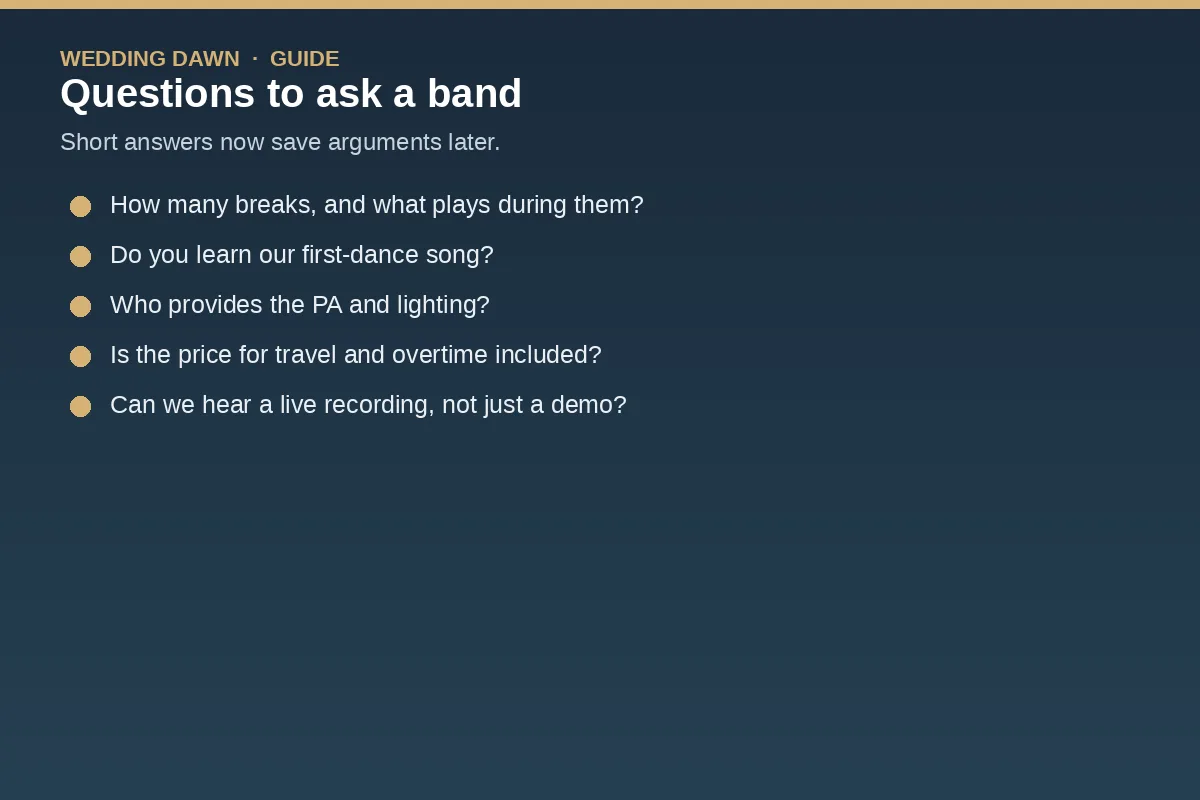
Watch live footage, not a studio demo. Then watch a full set from a wedding, including the moments between songs. How long do they talk? Do they tune silently or fill the gap? Do they look at the crowd or at each other? If you can, see them live at a public show or another wedding. Ask for two recent client references and actually call one. Ask the reference what went wrong, not what went right; the answer tells you whether the band is honest and how they handle problems. Also confirm who exactly plays: the person who answers your email is often not the person who will be on stage. Get the names and number of musicians for your date, and ask whether substitutions are allowed and on what standard.
Read the contract line by line
Wedding band contracts are usually short and full of assumptions. The deposit, balance due date, and cancellation terms are the obvious parts. The parts that cost money later are quieter: the overtime rate per hour, often charged in thirty-minute blocks; travel beyond a stated radius; meals for each musician; the cost of hiring their PA if the venue needs one; and who pays for parking or congestion charges. Check the force majeure and substitution clauses too. You want a named replacement standard, not the right to send a musician of equal ability. If the band cancels, the contract should say what happens to the deposit and how quickly they must tell you.
- Deposit amount, balance due date and accepted payment method.
- Overtime rate, minimum increment and who authorizes it.
- Travel radius, accommodation and meal arrangements.
- PA, lighting and microphone hire, and who operates them.
- Cancellation, postponement and force majeure terms.
- Public liability insurance and PAT testing certificates.
Sound, power and venue limits
Most venues have a noise curfew, and many have a decibel limiter wired into the power supply. Ask the venue for the limit and the curfew in writing, then pass both to the band before they quote. A band that has played the room before is worth a premium. Check power properly: a five-piece with a digital desk and LED lighting may need more circuits than the venue's single stage socket provides. Confirm who supplies extension leads, who runs the desk, and whether the band carries backup for a failed amp or laptop. If the band provides the PA, ask for its coverage specification and whether it includes a wireless microphone for speeches. Get the soundcheck slot into the schedule; a band loading in at five for a six o'clock ceremony is a recipe for feedback during the vows.
Build a realistic booking timeline
Popular bands book nine to twelve months out, and peak Saturdays go first. Work backwards from the date. Confirm the venue and its curfew first, shortlist five bands ten months out, book eight months out, sign and pay the deposit seven months out, then leave the detailed song discussion until two months before. Do not wait for the final guest count to book music; the count does not change the band, and the best ones will be gone.
- Twelve to ten months before: shortlist and watch full live sets.
- Nine months: check availability and request all-in quotes.
- Eight months: sign the contract and pay the deposit.
- Two months: setlist, first dance and MC notes.
- Two weeks: final timeline, load-in and meal times.
Plan the day-of logistics
Give the band one point of contact who is not the couple. Send a one-page brief: arrival time, parking, load-in door, green room, power location, set times, curfew, meal time, and the names of the people who will give cues. Bands do this every weekend; what they cannot guess is your venue's peculiarities. Confirm the meal arrangement, because hungry musicians play badly, and check whether drinks are included. Have a rain plan if the band is outside and a shade plan if the equipment sits in direct sun. Decide in advance who will make the play-one-more call and what the overtime rate is, so nobody is negotiating at midnight.
Red flags worth walking away from
- The quote is verbal and the contract only arrives after you pay.
- The lineup is described as up to six musicians, with no names.
- They cannot name a similar venue they have played recently.
- They will share a produced demo but no full live set.
- The overtime rate is missing, or the deposit is non-refundable with no postponement clause.
A wedding band is not a commodity you buy at the lowest price; it is the crew that decides whether your reception has a pulse. Do the room maths, fix the budget, watch them live, and put every promise in the contract. Then let them do their job, and get on the floor yourself.
Step by step
Measure the room
Write down capacity, dance-floor size, stage or floor space, ceiling height, power and curfew before shortlisting.
Fix the all-in budget
Set a number that includes travel, meals, PA hire and one overtime block, then compare quotes on that basis.
Watch a full live set
Judge set construction and between-song behavior, then call a recent client and ask what went wrong.
Confirm the exact lineup
Get names and instrument count for your date in the contract, plus the substitution standard.
Sign, deposit, brief
Check overtime, cancellation and insurance clauses, pay the deposit, then send a one-page day-of brief.
Quick checklist
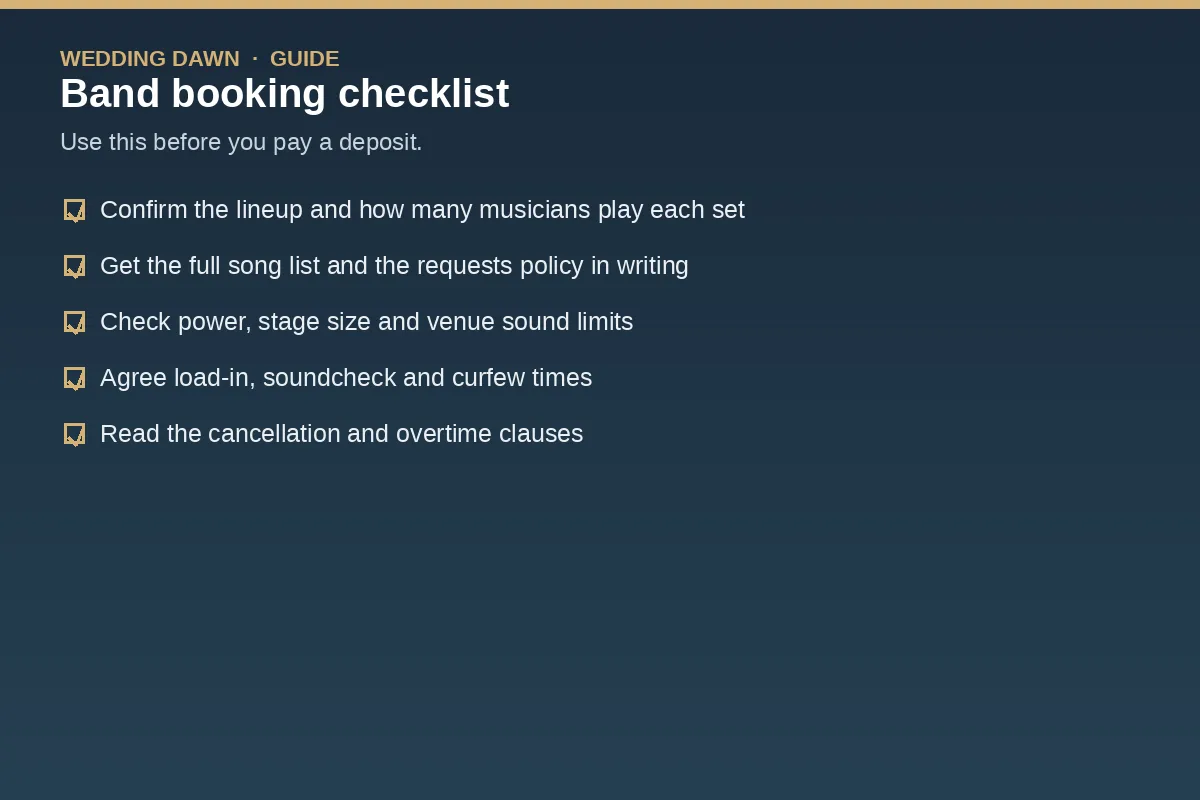
- Venue capacity, dance-floor size, power and curfew confirmed in writing.
- All-in quote itemised, including travel, meals, PA and one overtime block.
- Full live wedding set watched, not only a produced demo.
- Exact lineup names and substitution standard written into the contract.
- Day-of brief sent: load-in, soundcheck, set times, meals and cue contacts.
FAQ
How much should a wedding band cost?
In most markets a four-to-six-piece band sits in the low-to-mid four figures in dollars, before travel and extras; a ten-piece show band costs substantially more. Ask for an all-in itemised quote, because the headline fee often excludes travel, meals, PA hire and overtime.
Band or DJ: which fills the dance floor?
A good band creates a peak a playlist rarely matches, but a DJ gives you control over every song and costs less. If your guests span generations, a band for two sets plus a DJ or playlist for the gaps is often the most reliable combination.
How far in advance should we book?
Nine to twelve months for popular bands, and earlier for peak Saturdays. Book the venue and confirm its curfew first, because the room determines which bands are even viable.
Can the band learn our first-dance song?
Many will, sometimes for a fee, but confirm it in writing and ask for a rehearsal recording. If the song is unusual, agree a fallback: a stripped-back arrangement or a recording played while the band takes a break.
What if the band cancels?
The contract should state the notice period, the deposit refund and whether they must provide a replacement of comparable standard. Check their public liability insurance and keep all communication in writing.
Sources
- The Knot — Real Weddings Study Average US wedding spend on music and entertainment; checked 2026-11.
- Musicians' Union — contracts and booking guidance Standard contract terms, deposits and cancellation practice; checked 2026-11.
- HSE — Noise at work and event sound limits How decibel limits and hearing protection apply to live music events; checked 2026-11.