Unplugged Ceremony: How to Ask
An unplugged ceremony is a simple trade: twenty minutes without phones in exchange for everyone actually watching. It is not a rejection of technology, and it is not a comment on your guests' manners. It is a request, made early and clearly, that during the processional, the vows, and the recessional, the people you invited are present with you rather than narrating the moment to people who are not.
The idea fails when it arrives as a surprise. A sign at the door that nobody reads, or a tense announcement from a relative, produces resistance. Done properly, the request is built into the invitation, repeated at the entrance, and delivered once by the officiant, so that by the time the music starts, everyone already knows. This guide gives the wording, the placement, the exceptions, and the scripts for the awkward moments, without turning you into the phone police on your own wedding day.
Decide what is actually unplugged
Scope first. Some couples want the whole day phone-free; most want the ceremony only, with phones welcome at the reception. Both are valid, but they need different wording. A ceremony-only request is easy to follow because it has a clear start and end: the processional begins, the recessional ends, and then the party starts. A whole-day request has to explain what guests may do instead, and it usually needs a photographer plus a plan for group photos.
Name the exemptions before the day, so nobody has to negotiate at the aisle. Your officiant, photographers, videographer, and planner carry phones or cameras as part of the job. Readers and musicians may need a device for their notes. Anyone using a phone as a medical device, a hearing aid controller, or an accessibility tool is always exempt, and no one should have to explain why. Put these exceptions in your own head, not on the sign; the sign should stay short.
- Ceremony only is the easiest scope to explain and enforce.
- Exempt the working team: officiant, photographers, planner, musicians.
- Never question a guest using a device for health or access.
- Decide whether the wedding party may take photos before the ceremony starts.
Three touches, one message
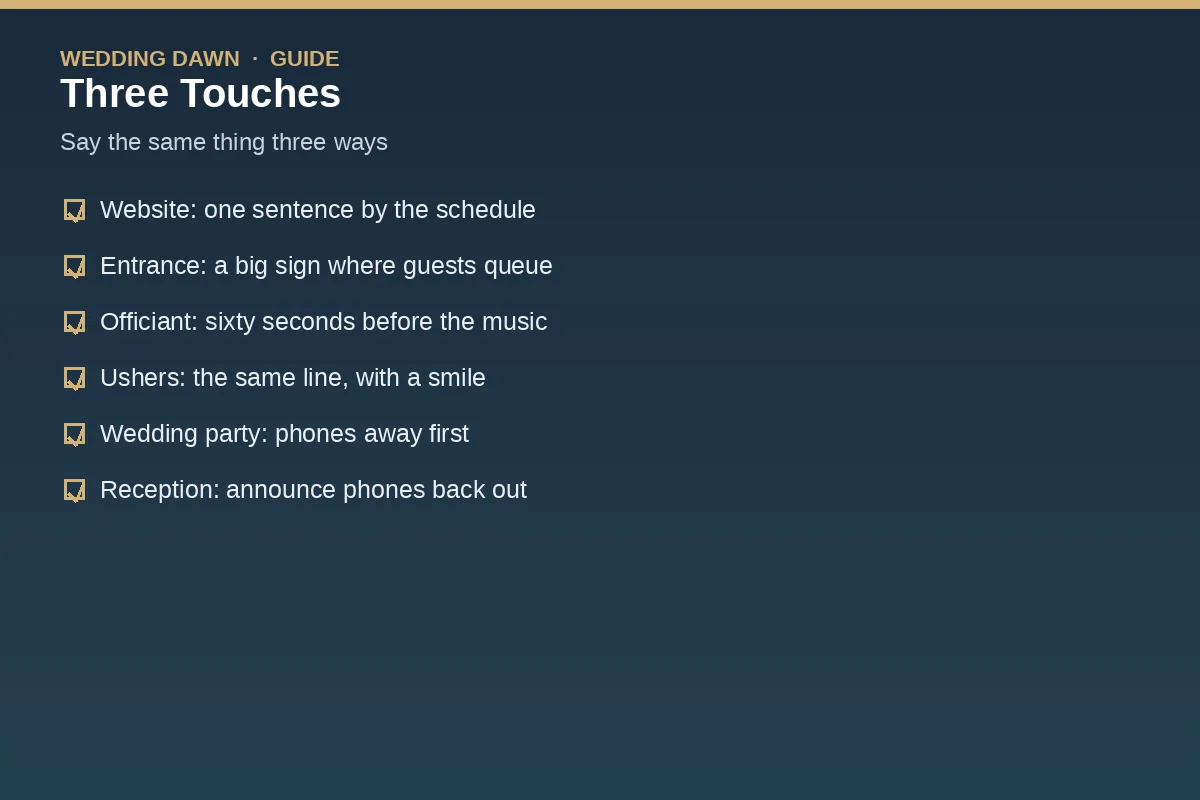
Guests need to hear the same instruction three times, in three different formats, before it sticks. The first touch is the invitation or the wedding website: a single sentence under the schedule, not a paragraph. The second is a sign at the entrance, placed where people queue rather than where they sit. The third is the officiant, sixty seconds before the processional, when everyone is quiet and looking forward.
Do not rely on the sign alone. People read it while walking, nod, and then reach for a phone the moment something lovely happens; the habit is stronger than the notice. The officiant's line works because it arrives at the moment of decision and comes from someone with social authority. If you have ushers, give them one sentence to repeat: 'Phones away for the ceremony, please; you'll have plenty of chances afterwards.' Consistency matters more than cleverness.
- Invitation or website: one sentence, near the schedule.
- Entrance sign: large, at eye level, where guests queue.
- Officiant: one short scripted request before the music.
- Ushers: the same sentence, said with a smile.
Signage wording that guests follow
The best sign is short, warm, and specific about the window. 'Please be fully here. Phones and cameras away until the recessional. Thank you.' That tells a guest what to do, when it ends, and why it matters. A close second: 'We're keeping this moment unplugged. Our photographers have it covered; we'd love your eyes, not your screen.' Both are polite and both give an instruction rather than a scold.
Avoid riddles, puns that need decoding, and paragraphs of explanation. A guest has about two seconds at the door. Use large type, high contrast, and one message per sign. Place it at the entrance to the ceremony space and, if the room is large, at the head of each aisle. If half your guests read another language, print both. Skip the line about 'respecting our wishes' if it is the only line; it explains nothing and sounds like a rule imposed from above.
- State the action: phones away, cameras away.
- State the window: until the recessional, or until we're married.
- Give a reason in one clause: we want your eyes, not your screen.
- Large type, eye level, one message, both languages if needed.
The officiant script, and what ushers say
Write the request for the officiant and hand it over a week early. Sixty to ninety words is enough: 'Before we begin, a request from the couple. They would love to see your faces, not your screens. Please silence your phones and keep cameras away until they are married. Their photographers will take care of the photos, and you will have every chance to celebrate afterwards. Thank you.' It is direct, it is warm, and it gives the reason.
Ask the wedding party to put their phones away first, visibly, before they walk. Guests copy the people closest to the couple, and a bridesmaid scrolling at the altar undoes the whole announcement. If someone still lifts a phone during the vows, do not stop the ceremony. Let the planner or a calm family member speak to them afterwards and ask for the clip. A confrontation at the altar costs far more than a single photo.
- Hand the officiant a written script a week before.
- Keep it under ninety words and give the reason.
- Wedding party phones away first, in view of guests.
- No mid-ceremony enforcement; handle it after, quietly.
The exceptions, and the pushback
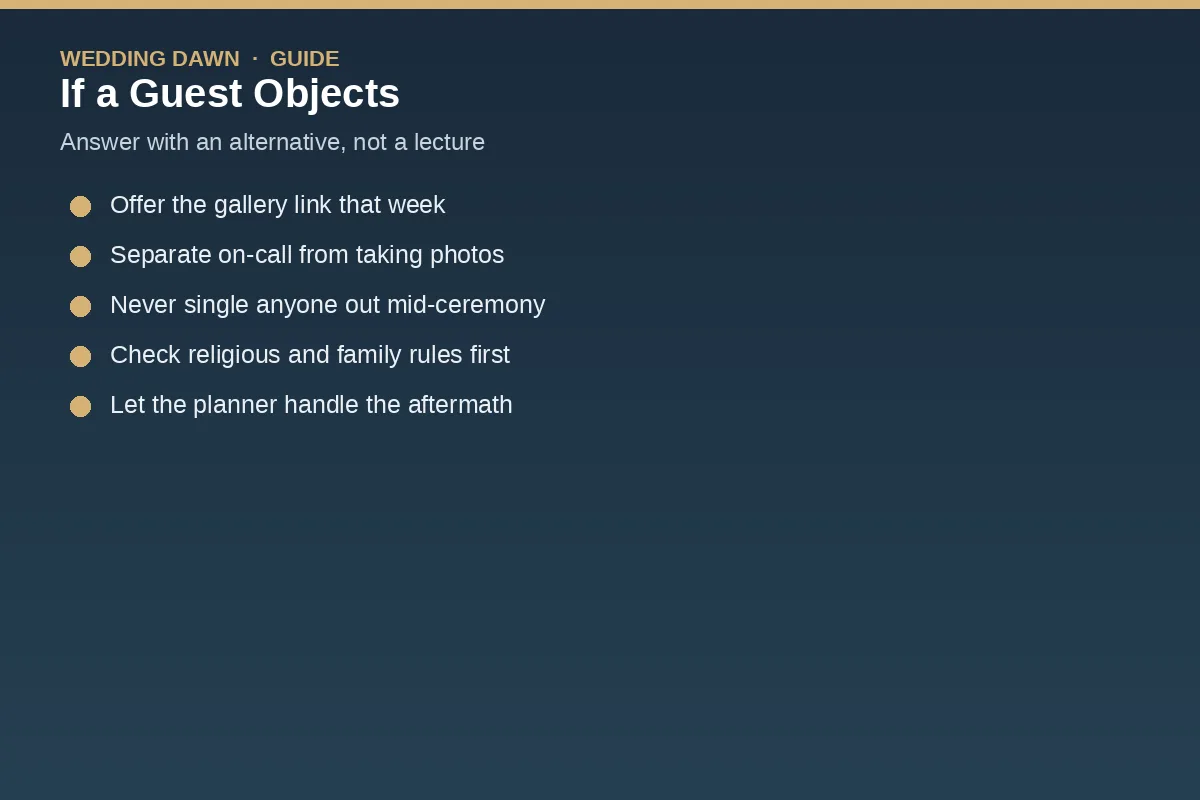
Someone will object, and it is usually someone who loves you. A grandmother who wants her own photograph, a friend who traveled far, a parent who paid and feels entitled to document the day. Do not argue about intent. Offer the alternative: 'Our photographers will send a gallery, and I'll make sure you get the link that week.' For the guest who is on call, say: 'Keep it on vibrate and step out if you need to; that's different from taking pictures.' The distinction is practical, and most people accept it.
There is also the cultural and religious layer. Some ceremonies have their own photography rules, and some families expect a formal photo at a specific moment. Ask before you publish the policy. If a religious leader requires something, work with it rather than announcing a rule the ceremony itself contradicts. And never single out a guest from the front of the room, even gently; the correction is remembered longer than the photo.
- Answer objections with the gallery link, not a lecture.
- Separate 'on call' from 'taking photos' in your wording.
- Check religious and family expectations before printing signs.
- Never call out an individual guest during the ceremony.
Release the phones at the reception
The ceremony ends, and the request should end with it. Announce the release: 'We're married. Phones out.' It gives guests permission, it signals the party, and it prevents the awkward in-between where people are unsure whether the rule still applies. Put a QR code or a short hashtag on the tables if you want guest photos, and ask one friend to save stories to a shared album so the collection actually happens.
Tell your photographer what you decided. They will shoot the ceremony without dodging screens, and they can plan the candid work for the reception. Decide in advance what you want back: a curated gallery, a shared album, or prints for parents. If you would rather not have a public hashtag, say so on the same card; a private album link does the same job without exposing your guests.
- Announce the end of the request at the recessional.
- Share a private album link or a short hashtag at the tables.
- Ask one friend to collect stories into the album.
- Tell the photographer the plan before the day.
A four-week timeline
Four weeks out, write the sentence and add it to the website. Three weeks out, order the signs and send the officiant the script. Two weeks out, tell the wedding party and the ushers what you are asking and why. The week of, place the signs at the queue and walk the route yourself to check the sight lines. On the day, brief the planner at the rehearsal and let them handle anything that goes wrong. After the wedding, send the gallery link to the people who asked.
- Four weeks: website sentence and sign order.
- Three weeks: officiant script and usher briefing.
- Two weeks: wedding party informed; exemptions agreed.
- Week of: place signs, walk the entrance, check sight lines.
- Day of: planner handles exceptions; no confrontation.
- After: gallery link to anyone who asked.
Step by step
Choose the window
Ceremony only is easiest. Name the start and end: processional to recessional.
Write one sentence
Website, sign, and officiant script all say the same thing.
Print for the queue
Large type, eye level, one message, both languages if needed.
Brief the team
Officiant, ushers, wedding party, planner. They model it first.
Release and collect
Announce phones out at the recessional; share a private album link.
Quick checklist
- Scope decided: ceremony only or whole day.
- One-sentence request on the website.
- Signs printed large, placed at the queue.
- Officiant script delivered a week ahead.
- Ushers given the same sentence.
- Wedding party briefed to put phones away first.
- Exemptions agreed: team, health, access, religious rules.
- Plan for pushback agreed with the planner.
- Recessional release announced.
- Private album or hashtag ready for guest photos.
FAQ
Is an unplugged ceremony rude to guests?
No, if it is asked once, early, and with a reason. A short window with a clear end is easy to follow; a vague request or a mid-ceremony correction is what feels rude.
Do we have to keep phones away all day?
No. Most couples unplug the ceremony only and welcome phones at the reception. Decide the window, state it, and release it clearly at the recessional.
What about elderly relatives who want their own photos?
Offer the gallery link and, if it matters, ask the photographer for one print. Explain that the professional photos will be better than a phone shot from row four.
What if a guest ignores the request?
Do not stop the ceremony. Let the planner or a family member speak to them afterwards and ask for the clip. One photo is not worth a scene at the altar.
How do we get guest photos afterwards?
Announce that phones are welcome at the reception, share a private album link or a short hashtag, and ask one friend to collect stories. A public tag page is optional and less private.
Sources
- Emily Post Institute — Etiquette advice Guest consideration and hosting etiquette, reviewed 2026-11.
- ADA National Network — Accessibility Accommodation principles applied to ceremony requests, reviewed 2026-11.
- NIST — Privacy Framework Image sharing and guest privacy, reviewed 2026-11.