Engagement Ring Guide: 4Cs, Styles & Budget
Buying an engagement ring is usually the first big jewelry purchase anyone makes, and it is easy to feel out of your depth the moment you walk into a store or open a diamond site. The jargon is dense, the prices swing wildly for differences you cannot see, and the pressure to 'get it right' is real. This guide strips the process back to what actually matters: how to set a budget you can keep, what the famous 4Cs really tell you, how to pick a style that fits the person and their everyday life, how natural diamonds compare with lab-grown and alternative stones, and the quiet mistakes that waste thousands. Read it before you shop and you will walk in with the same information the salesperson has — which is exactly where the power sits.
Set the budget before you look at anything shiny
The single most useful thing you can do is decide what you can comfortably spend before you see a single ring. The old 'two months' salary' rule is a marketing line from the 1980s, not a financial plan, and it pushes people into debt for a stone they cannot really afford. Start from your actual savings and cash flow: a ring you finance at 25 percent APR costs far more than its tag by the time it is paid off. A sane approach is to cap the ring at what leaves you with a real emergency fund still intact, then shop strictly inside that number. If you are also planning the wedding, agree how much of the joint budget the ring takes so it does not quietly eat the caterer. Most couples are happiest when the ring feels generous but never stressful, and that is a number you set, not a rule you inherit. Our wedding budget breakdown walks through where the ring sits next to everything else.
The 4Cs — and where they stop telling the truth
Every diamond is graded on cut, color, clarity, and carat weight. Cut is by far the most important: it is what makes a stone sparkle, because it controls how light leaves the top of the diamond. A smaller stone with an excellent cut outshines a larger, poorly cut one every time. Color runs from icy white (D) toward faint yellow (Z); most people cannot tell the difference past the first few grades, so paying for a D over an F is often wasted money. Clarity measures internal flaws (inclusions); most are invisible to the naked eye, so a 'slightly included' grade usually looks identical to a flawless one on the finger. Carat is simply weight, and price jumps sharply at whole numbers — a 0.9-carat stone can look the same as a 1.0 but cost far less.
- Cut drives the sparkle — choose excellent cut over a bigger size.
- Color past the first few grades is hard to see; do not overpay for D.
- Clarity flaws are usually invisible; 'slightly included' is fine on the hand.
- Carat is weight, and prices jump at 1.0, 1.5, 2.0 — buy just under.
Pick a style that fits the hand and the life
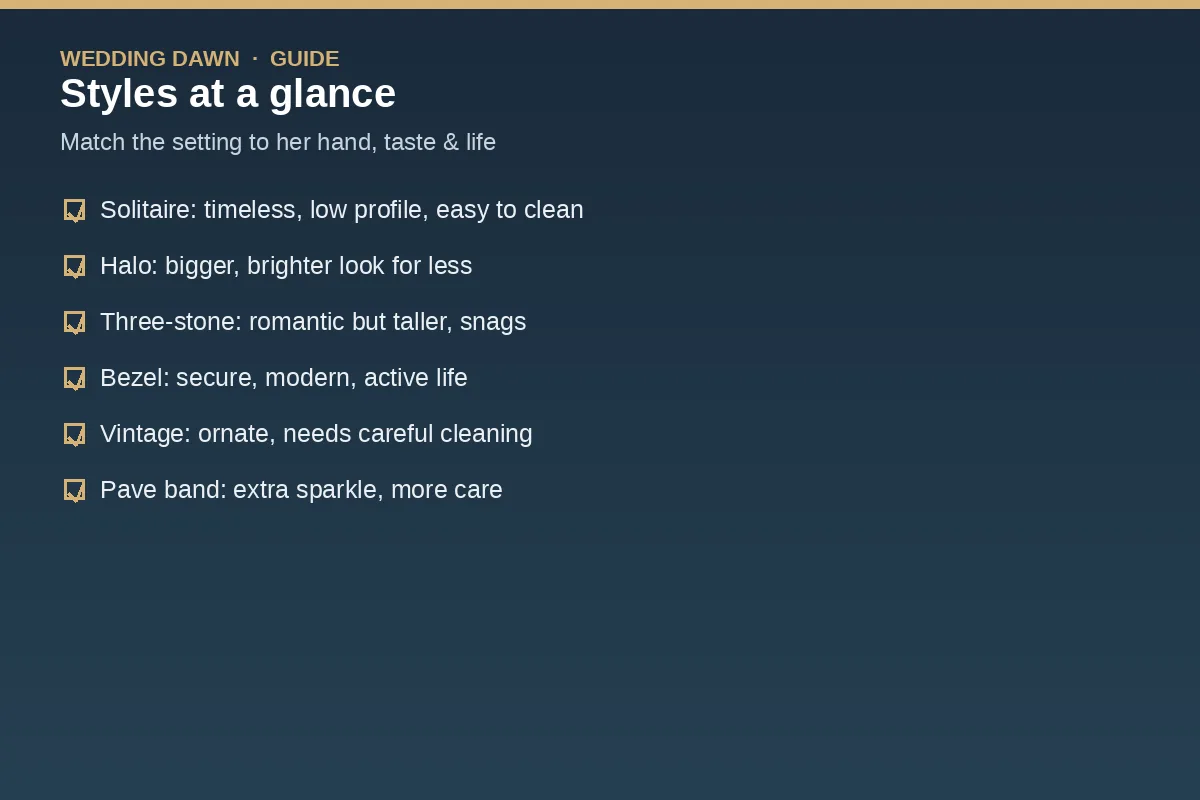
The setting is what makes a ring feel like hers, and it should match how she lives. A solitaire — one stone, plain band — is timeless, low-profile, and easy to clean. A halo wraps the center stone in tiny diamonds so it reads bigger and brighter, at a lower cost than a larger center. A three-stone setting carries romance (past, present, future) but sits higher and catches on things. A bezel setting wraps metal around the stone for a modern, secure look that suits an active job or hands-on life. Vintage and milgrain styles are ornate and distinctive but need more careful cleaning. Match the profile to her daily routine: a nurse, climber, or teacher often prefers a low, secure setting over a tall, delicate one.
Natural, lab-grown, or an alternative stone
You now have three real options. A natural diamond is mined, carries the strongest resale and tradition, and costs the most. A lab-grown diamond is physically and chemically identical — same sparkle, same hardness — but typically costs 40 to 70 percent less for the same size and quality, because no mining and no scarcity markup. The trade-off is resale: lab stones hold far less value secondhand. Beyond diamonds, sapphires and moissanite are popular alternatives — sapphire for color and durability (it is the engagement-stone choice of several royal families), moissanite for near-diamond brilliance at a fraction of the price. There is no 'wrong' answer; there is only the one that fits the budget and the story you want to tell. Decide this early, because it changes every price you see.
Get the size right without spoiling the surprise
A ring that does not fit is a fixable problem, but a surprise proposal is easier if the size is close. The cleanest method is to borrow a ring she already wears on the correct finger and have a jeweler measure it, or trace its inner circle on paper. A piece of string around her finger while she sleeps is a rougher but workable backup. If you are unsure, our ring and dress size converter turns a measurement into a standard ring size you can hand to the jeweler. Most rings can be resized a notch or two after the fact, so do not panic if you are half a size off — but tell the jeweler the style, because some settings (especially full pavé or eternity bands) are hard or impossible to resize. When in doubt, propose with a simple placeholder band and buy the real stone together afterward; plenty of couples prefer choosing it as a pair.
Where to buy, and the paperwork that protects you
You can buy from a local jeweler, a big-box store, an online-only retailer, or a custom designer. Local shops offer hands-on service, resizing, and a relationship you can return to; online stores often beat them on price for the same certificate. Whichever you choose, insist on an independent grading report from GIA or IGI — not a store's own 'certificate', which means little. The report describes the exact stone so you can compare like for like. Also get a written appraisal (for insurance, not for value) and confirm the return window, the resizing policy, and whether the center stone is covered if it chips. A reputable seller answers these without hesitation; a hesitant one is a reason to walk away.
Mistakes that quietly waste the money
The expensive errors are predictable. Chasing a full 1.0 carat and paying a huge premium over a 0.9 that looks identical. Pouring the budget into carat while ignoring cut, so the stone is big but dull. Buying a fragile, tall setting for someone with an active life, then watching it snag. Skipping the certificate and trusting a verbal grade. Forgetting that the band needs resizing, or that the stone needs insuring the day it goes on her finger. And buying far too early, before you know her taste, so the ring spends months in a drawer. None of these is about taste — they are about shopping with a plan, which is what this guide is meant to hand you before you walk in.
When to start shopping
Timing saves money and nerves. Start looking two to three months before you plan to propose so you have room to compare certificates, wait for a sale, and handle resizing or engraving without paying for rush service. A custom or fully bespoke ring can take six to eight weeks or more, so begin earlier if that is the route. If the proposal date is fixed and close, a simpler in-stock solitaire or a placeholder band keeps you on schedule, and the center stone can be upgraded later. The couples who feel calm at the counter are the ones who started before the calendar got tight, not the ones who panic-bought the week of.
Step by step
Set a real budget
Decide what you can spend while keeping an emergency fund, before you see any ring.
Learn the 4Cs and light
Prioritize cut and sparkle over carat; understand where grades stop mattering visually.
Match the setting to her life
Pick a style and profile that fits her hand, taste, and daily routine, not just a photo.
Choose stone type
Decide natural, lab-grown, or an alternative like sapphire or moissanite before pricing.
Verify size, cert, policy
Confirm ring size discreetly, insist on GIA/IGI report, and get return and resize terms in writing.
Quick checklist
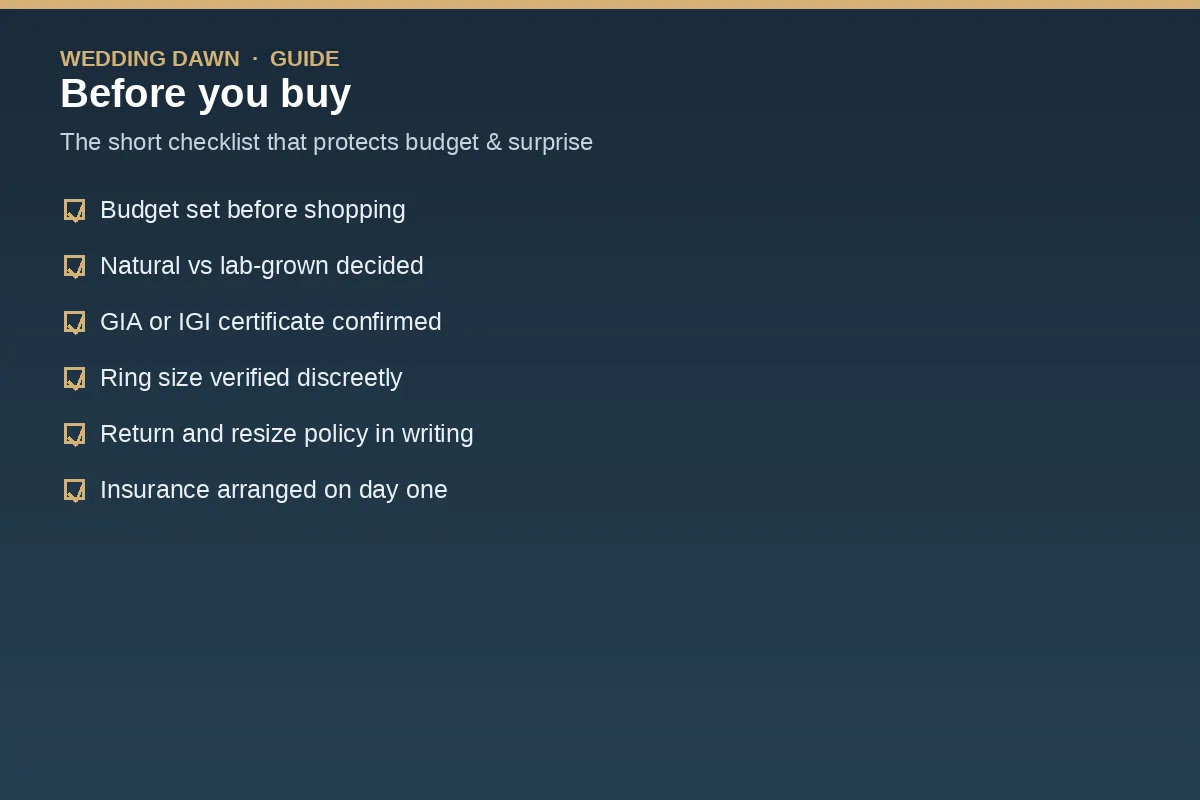
- Budget set before shopping, with emergency fund still intact.
- Style matched to her hand, taste, and daily life — not just a styled photo.
- Stone type decided: natural, lab-grown, or an alternative.
- Independent GIA or IGI certificate confirmed for the exact stone.
- Ring size verified discreetly and return/resize policy in writing.
FAQ
How much should I spend on an engagement ring?
Spend what fits your savings and cash flow while keeping an emergency fund, not the old 'two months' salary' rule. Most people are happiest with a ring that feels generous but never stressful, and that number is yours to set.
Is a lab-grown diamond worth it?
A lab-grown diamond is physically and chemically identical to a natural one and typically costs 40 to 70 percent less for the same size and quality. The trade-off is weaker resale, so choose it if the budget and story matter more than future value.
What certificate should I look for?
Insist on an independent grading report from GIA or IGI for the exact stone. A store's own 'certificate' is not comparable and makes it impossible to compare like for like across sellers.
How do I find her ring size without spoiling the surprise?
Borrow a ring she already wears on the correct finger and have a jeweler measure it, trace its inner circle, or use our ring size converter from a string measurement. Most rings resize a notch or two afterward.
Can I finance an engagement ring?
Yes, many retailers offer financing, but high APRs can add a large premium over the tag. If you finance, compare the total paid and prefer a 0 percent plan you can clear before interest starts.
Sources
- GIA — 4Cs of Diamond Quality Official explanation of cut, color, clarity, and carat; checked 2026-11.
- IGI — Diamond and gemstone grading Independent grading reports used to compare stones like for like; checked 2026-11.
- The Knot — engagement ring cost survey Typical spend ranges and buying trends by region; checked 2026-11.