Bridesmaid Dresses: Colors, Fit and Budget
The most common bridesmaid dress problem is not taste. It is that one dress has to work for six different bodies, six budgets and six calendars, and the decision gets made in a group chat where nobody wants to be the person who says no. The result is a dress that half the party tolerates, ordered late, altered in a rush, and worn once.
This guide treats the dress as a small project with three decisions: palette, budget and fit. Get those three right and the rest — fabric, shoes, jewelry — mostly solves itself. Get them wrong and no amount of Pinterest boards will fix it.
Decide the palette, not the dress
Start with the wedding's own colors and the venue. A late-afternoon garden ceremony and a hotel ballroom want different saturation. Ask the photographer what reads well in the room where you will actually be photographed, not in a showroom with white light.
Then pick a palette of two or three colors and one neutral. Three is the practical maximum; beyond that the group photo turns into a color chart and the eye has nowhere to rest. A neutral — champagne, slate, sage, taupe — lets you place people with different coloring in the same frame without anyone looking washed out.
One shade, three depths
The simplest version that still looks intentional: everyone in the same color, but allowed to choose between three depths (light, mid, deep) or three necklines. This is often called a shade card. It keeps the photo coherent and lets each person pick what suits her skin tone and the level of support she wants.
Give people a physical swatch, not a screenshot. Screens shift color, and two phones will show two different teals. Order swatches from the manufacturer, keep one in your bag, and write the exact color name and code in the group chat so nobody orders "the green one" from a third-party seller.
Mix and match without looking mismatched
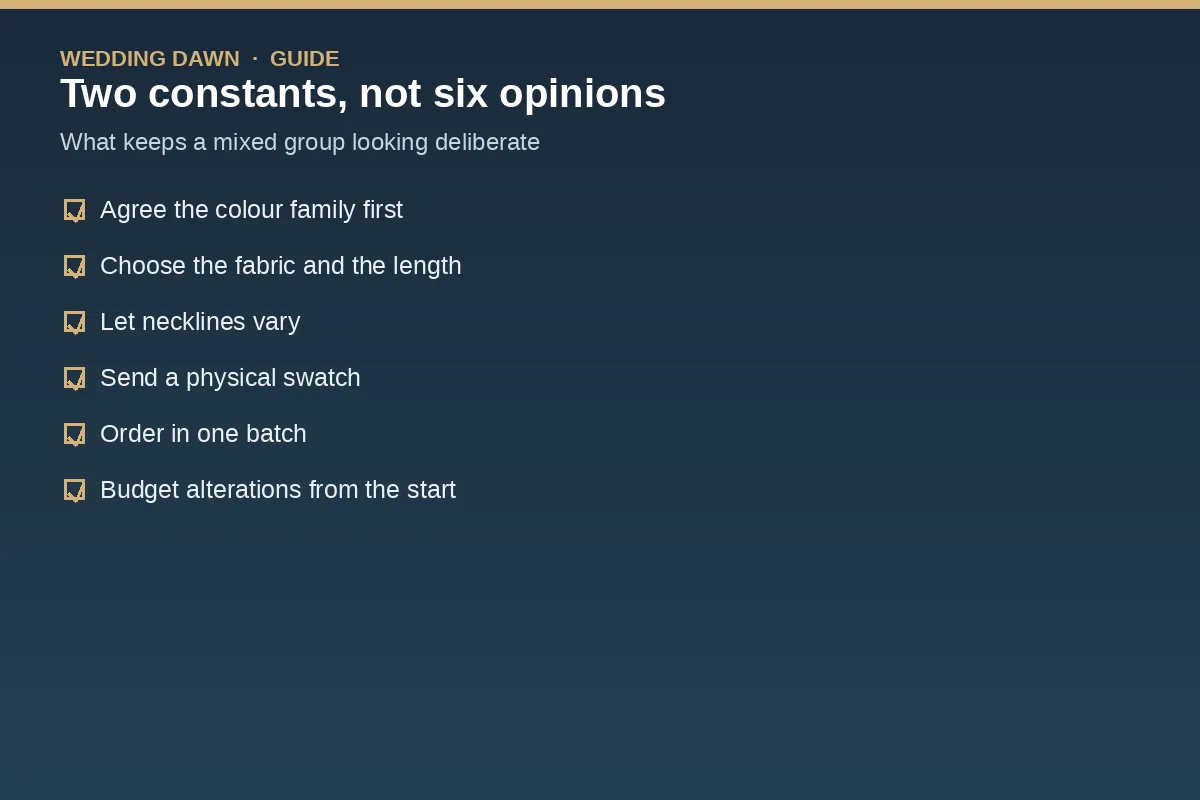
Mix and match fails when there is no rule. Give two rules and it works: same fabric, same length, different neckline — or same color family, same length, different fabric. Two constants are enough to hold the group together; the variable is where people get to be themselves.
Avoid mixing very different formalities. A satin floor-length gown next to a cotton knee-length sundress reads as an accident rather than a choice. If the wedding is formal, keep the fabric formal and vary the cut. If it is relaxed, keep the length consistent and vary the color.
Be careful with prints. One floral print among five solids can look lovely; five different prints look like a wedding guest list, not a wedding party. If you want print, choose one print and vary the ground color, and make sure the scale of the print suits the smallest and largest person in the group.
Set the budget before the group chat
Ask what people can genuinely spend, privately, and give a range rather than one number. "The dresses are around 120 to 180, plus alterations" is a sentence people can plan around. A single number with no room feels like a bill.
State clearly who pays. In many circles the bridesmaid buys her own dress, but that is a custom, not a law, and it is worth saying out loud before anyone orders. If the couple is paying, say so early; if the party is splitting a rental, say what the deposit and damage policy are.
Build in the costs people forget: alterations (often 30 to 80 for a hem and straps), shoes, undergarments, and the second outfit if there is a cultural ceremony. A dress that is 150 with 70 of alterations is a 220 dress, and pretending otherwise is how resentment starts.
Rental is now a real option for a single-day dress. Compare the rental price including shipping both ways and the damage waiver against buying on sale. Rental wins when the dress is formal, worn once, and unlikely to be altered well; buying wins when the fit is difficult or the dress could be worn again.
Fabrics that survive a long day
Cotton and cotton blends breathe and photograph softly; they wrinkle, so plan for a steamer. Chiffon is forgiving of fit and hides a multitude of sins, but it tears at stress points and shows every crease in a car. Satin photographs beautifully and shows every drop of sweat. Crepe is the quiet workhorse: it drapes, resists wrinkles and looks expensive in photos.
Ask what the fabric does under an iron and in a car. If the answer is "it needs professional pressing", add that to the budget. If it is a July wedding outdoors, avoid heavy lining and dark saturated colors that show heat patches; if it is December, a light shawl is worth more than a heavier dress.
Fit, measurements and the alterations nobody budgets
Never order from a size chart alone and never ask people to "just order their usual size". Dress sizing runs small and varies by brand. Measure bust, waist and the widest part of the hips, then order to the largest measurement and plan to take in. Taking in is easy; letting out is often impossible because seam allowances are cut short.
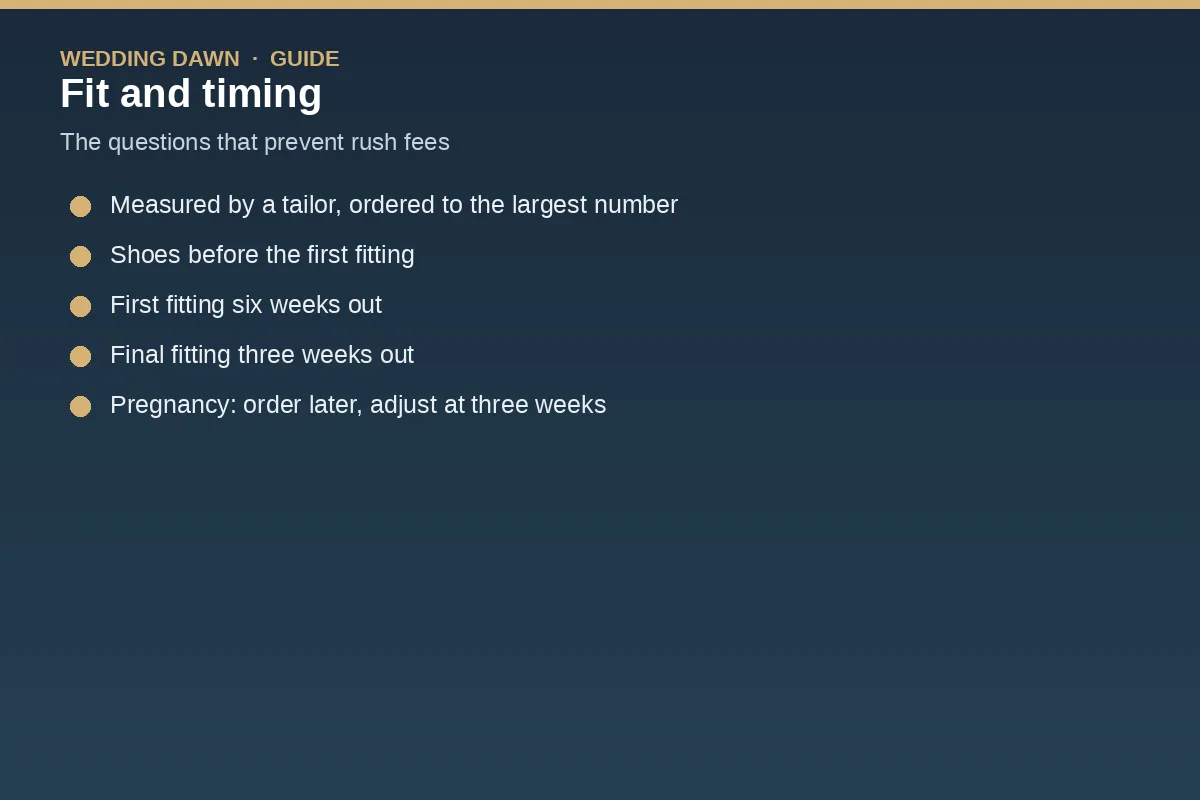
Ask each person to be measured by a tailor, not by a friend with a tape measure in a kitchen. If shopping online, check the return policy before ordering and order one size up when between sizes. For anyone pregnant or nursing, order later and choose a style with a wrap or adjustable back; bodies change fastest in the last trimester and the first months after.
Get the shoes before the first fitting. Hem length depends on heel height, and a hem cut for flats will hover above the floor in heels. Bring the actual underwear and bra you plan to wear to the fitting; straps and necklines behave differently over a different bra.
The ordering timeline that survives delays
Work backwards from the wedding. Allow twelve to sixteen weeks for made-to-order dresses, two to four weeks for alterations, and two weeks of buffer for a remake. That means ordering about five months out for a standard wedding and six for a destination or a custom color.
Order every dress in the same batch if the color matters. Dye lots differ, and a dress ordered three weeks later can arrive a shade off. If someone joins late, order a swatch first and compare it in daylight before committing.
Track the order in one place: who ordered, size, date, tracking number, arrival, fitting date. A shared spreadsheet beats a group chat where the important message is buried under photographs of shoes.
Pregnancy, nursing and changing bodies
Ask early and without drama. A bridesmaid who is pregnant, nursing or planning to be will need a different timeline and often a different style. Empire waistlines, wrap fronts and adjustable backs are the practical choices, and a seamstress can add hidden nursing access to many dresses.
Do not order a smaller size "for after the baby". Order for the body that will be in the photographs, and plan an alteration three weeks out. The same applies to anyone losing or gaining weight for medical reasons: a dress is not a motivational tool.
Shoes, layers and the small stuff
Let people choose their own shoes within a color and heel range. Matching shoes are the fastest way to make a group look like a uniform, and mismatched comfort levels show in the photos. Agree on a heel height range so hems can be cut consistently.
Provide or suggest a wrap or cardigan in the palette. Venues are cold, and a borrowed pashmina in the wrong color undoes the palette in every candid. A small budget for a matching layer is money well spent.
Skip the matching jewelry unless it is a gift. Cheap matching necklaces read as cheap; a single meaningful piece per person, or nothing, photographs better. If you are giving a gift, give it before the wedding day so it can actually be worn.
Group chat rules that keep friendships
One decision-maker, one channel, one deadline. The bride or a designated point person posts the palette, the budget range, the order date and the link; everyone replies with size and confirmation. Opinions are welcome before the decision and not after.
Do not run a vote on a color with eight people. Votes produce the most average option and leave the losers resentful. Choose the palette, explain the reason in one sentence, and let people choose within it.
Never comment on anyone's body in the chat. "That will look great on you" is fine; "you should cover your arms" is not. If someone is uncomfortable, handle it privately with the point person, not in front of the group.
After the wedding
Ask about cleaning before the day, not after. Some fabrics are dry-clean only and some will be ruined by a well-meaning washing machine. Tell people what the dress needs and whether you want it back.
If the dresses were bought by the party, they keep them. If they were rented or bought by the couple, agree on returns before the wedding. A labelled bag per person, handed out at the rehearsal, prevents the morning-after scramble.
Step by step
Lock the palette in one message
Two or three colors plus a neutral, with a physical swatch and the exact color code. One sentence on why, then no more voting.
Ask budgets privately, give a range
Ask each person what she can spend, then publish a range and say who pays and what alterations typically cost.
Choose two constants
Same fabric and length, or same color family and length. Let necklines and depth vary so each person can choose what fits.
Measure and order to the largest number
Bust, waist, widest hip, measured by a tailor. Order one batch, one size up between sizes, and keep the swatch for late joiners.
Book fittings six and three weeks out
Shoes and underwear at the first fitting, final hem and straps at the second. Two weeks of buffer before the wedding.
Quick checklist
- Palette of two or three colors plus one neutral, written down with codes
- Physical swatch ordered and kept by the point person
- Budget range agreed privately and published with who pays
- Alteration cost estimate included (hem and straps)
- Two constants chosen: fabric and length, or color family and length
- Each person measured by a tailor, not a friend
- Order placed in one batch, one size up between sizes
- Order date at least five months out, six for destination
- Shoes chosen before the first fitting
- First fitting six weeks out, final fitting three weeks out
- Pregnancy or nursing needs asked early and style adjusted
- One spreadsheet with size, date, tracking and fitting for each person
FAQ
Should bridesmaids pay for their own dresses?
It depends on local custom and the couple's budget, but the important thing is to say it clearly before anyone orders. If the party pays, publish a range that includes alterations; if the couple pays, confirm it in writing so nobody assumes.
How many months before the wedding should bridesmaid dresses be ordered?
About five months for standard made-to-order dresses and six months for a destination wedding or a custom color. That allows twelve to sixteen weeks production, two to four weeks of alterations and a two-week buffer.
Is it cheaper to rent or buy bridesmaid dresses?
Rental usually wins for a formal dress worn once, once you include shipping both ways and the damage waiver. Buying wins when the fit is difficult, when the color must match exactly, or when the dress will be worn again.
Can bridesmaids wear different dresses?
Yes, if you keep two constants. Same fabric and length with different necklines, or the same color family and length with different fabrics. Without constants the group photo looks accidental rather than chosen.
What if a bridesmaid is pregnant?
Ask early and order later. Choose a wrap front, empire waist or adjustable back, and book an alteration about three weeks before the wedding. Do not order a smaller size for after the birth.
How do I handle a bridesmaid who cannot afford the dress?
Offer a rental, a sale option or a contribution from the couple without announcing it to the group. Quietly covering the gap protects the friendship and the photos more than cutting the whole party's budget.
Sources
- Wedding dress alterations and fit guidance — consumer tailoring associations Industry guidance on measuring, seam allowances and alteration limits; checked 2026-11.
- FTC Consumer Advice — shopping for a wedding or event Deposits, contracts, cancellation and delivery delays; checked 2026-11.
- Textile care guidance — dry cleaning and fibre care labels Fibre care and labelling rules behind the wash and dry-clean instructions on garments; checked 2026-11.